
Costa Rica GDP Per Capita: Economic Overview and Living Standards
Costa Rica's GDP per capita places it among the most prosperous nations in Latin America, reflecting decades of sustained economic growth driven by diversification beyond agriculture into high-tech manufacturing, medical devices, tourism, and business services. The country achieved this prosperity through consistent investment in education, healthcare, and democratic institutions rather than natural resource extraction — a development path that distinguishes it from many of its Central American neighbors. Understanding Costa Rica's economic performance illuminates how national policy choices translate into living standards, inequality, and development outcomes over time.
Costa Rica GDP Per Capita: Current Figures
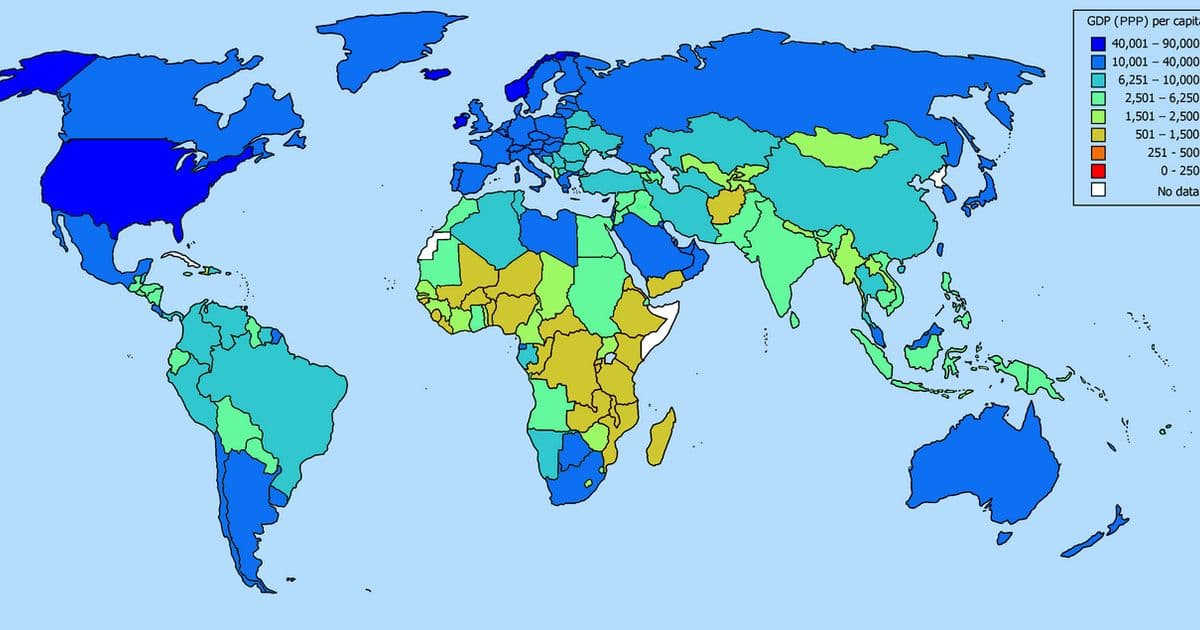
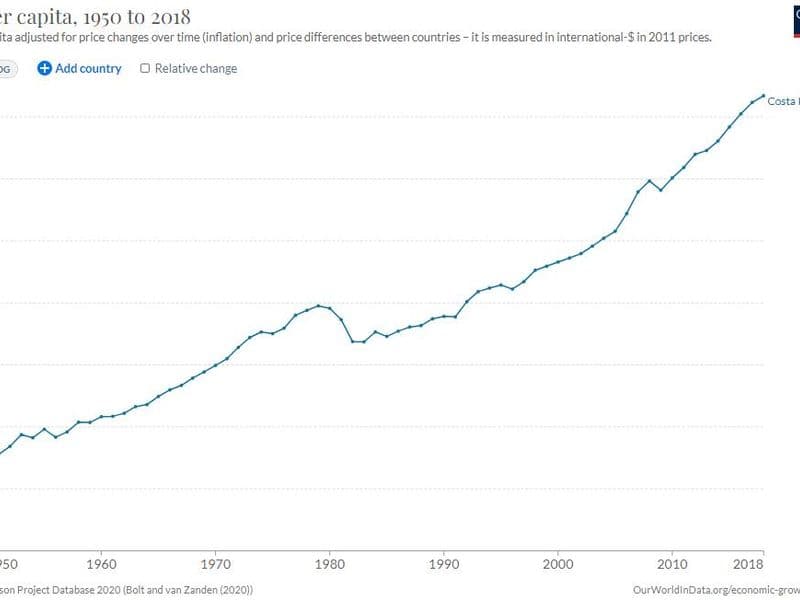
Costa Rica's GDP per capita (current US dollars) has grown substantially over the past three decades, rising from approximately $2,000 in the early 1990s to over $13,000 in nominal terms by the early 2020s. In purchasing power parity (PPP) terms — which adjust for local price levels and provide a more accurate comparison of living standards — Costa Rica's GDP per capita was approximately $22,000–$24,000 PPP international dollars by 2023, based on World Bank and IMF data. This places Costa Rica among the upper-middle-income nations globally and significantly above the Central American regional average.
Costa Rica's total GDP (gross domestic product) is approximately $70–$80 billion USD in nominal terms (varying with exchange rates and annual growth), making it one of the larger economies in Central America despite a population of just under 5.2 million people. The economy has grown at an average annual rate of approximately 3–5% over the past decade, though growth dipped during the COVID-19 pandemic in 2020 before recovering strongly in 2021–2022.
The GDP per capita figure, while important, does not fully capture living standards because Costa Rica maintains significant income inequality (discussed below). The median household income and access to public services like universal healthcare (CAJA) and public education shape actual living standards more directly than per capita averages for large portions of the population. Costa Rica's strong public service infrastructure — particularly healthcare and education — means that quality of life indicators often exceed what the per capita income figure alone might suggest.
Nominal vs. PPP GDP Per Capita
Nominal GDP per capita measures income in current U.S. dollars at market exchange rates. PPP GDP per capita adjusts for the fact that prices in Costa Rica are lower than in high-income countries — goods and services cost less in colones than their dollar equivalent would in the United States. PPP measures are therefore a better indicator of actual purchasing power and living standards. Costa Rica's PPP per capita of $22,000–$24,000 (2023 estimate) is meaningfully higher than its nominal figure of around $13,000–$14,000.
Economic History and Development Model
Costa Rica's economic development trajectory diverges sharply from most of its Central American peers and offers lessons in long-term development strategy. The coffee economy of the 19th century generated the revenues that funded initial public infrastructure and institutions. Unlike many countries where coffee wealth concentrated in a small elite, Costa Rica developed a larger smallholder farming class (due in part to colonial land distribution patterns and the Central Valley's geographic constraints on large landholding) that supported a broader middle class.
The 1949 constitution established foundations that proved economically significant over time: universal public education funded by a constitutional minimum of 8% of GDP, universal healthcare through the CAJA system, nationalization of commercial banking (later partially reversed), and prohibition of the military (redirecting resources to social investment). These choices created human capital and social stability that attracted foreign investment and enabled economic diversification in subsequent decades.
The 1980s brought severe economic crisis — hyperinflation, debt restructuring, and a painful structural adjustment period under IMF guidance. Recovery in the 1990s was accompanied by trade liberalization, export diversification, and a landmark investment by Intel Corporation in 1997 that established Costa Rica's reputation as a viable high-tech manufacturing location. Intel's Costa Rica semiconductor assembly plant (which closed in 2014 but was followed by other tech investments) catalyzed the free trade zone model that continues to attract multinational manufacturing today.
The Free Trade Zone Model
Costa Rica's Régimen de Zona Franca (Free Trade Zone regime) has been central to economic diversification since the 1990s. Companies operating in approved zones receive significant tax incentives including import duty exemptions and income tax reductions in exchange for export commitments and local employment. Medical device manufacturing (Abbott, Boston Scientific, Medtronic), advanced services (software, financial back-office), and agro-processing are the primary free trade zone sectors. Zona Franca exports account for more than 60% of Costa Rica's total export earnings.
Key Industries Driving Costa Rica's Economy
Medical device manufacturing has become the single most important export sector in Costa Rica, surpassing traditional agricultural exports. Companies including Abbott, Boston Scientific, Medtronic, Baxter, and Smith+Nephew operate manufacturing and assembly facilities in Costa Rican free trade zones, particularly in the Coyol, Cartago, and Alajuela industrial parks. Medical device exports exceeded $4 billion USD annually in recent years, making Costa Rica one of the top medical device exporters in the Americas and the world on a per-capita basis.
Tourism is the second most important economic sector and the largest single employer in the service sector. The Costa Rican Tourism Board (ICT) estimates that tourism contributes approximately 8% of GDP directly and more when indirect effects are counted. In pre-pandemic peak years, Costa Rica welcomed over 3 million international visitors annually, generating over $4 billion in foreign exchange earnings. Tourism's linkages to the accommodation, transportation, food service, and guide industries create broad economic benefits across regions and income levels.
Business process outsourcing (BPO) and shared service centers represent a rapidly growing sector. Costa Rica's educated, bilingual workforce, stable legal environment, and competitive costs relative to the United States have attracted operations from companies including Amazon, DXC Technology, HP, and numerous financial services firms. These centers provide customer service, IT support, accounting, and legal processing services for North American parent companies, employing tens of thousands of Costa Ricans in well-paying service jobs in the San José metropolitan area.
Agriculture and Traditional Exports
Costa Rica's traditional agricultural exports — bananas, pineapples, coffee, and palm oil — remain important contributors to the economy despite being surpassed by manufacturing exports. Costa Rica is consistently among the world's top three pineapple exporters and a major banana exporter. Specialty coffee from regions like Tarrazú, Naranjo, and Brunca commands premium prices in global specialty coffee markets. Agricultural exports support rural employment and community economies in regions far from urban centers.
Tourism and Its Economic Contribution
Tourism's contribution to Costa Rica's GDP per capita is multifaceted and extends well beyond direct hotel and tour operator revenue. The sector generates employment for naturalist guides, transportation operators, restaurant workers, artisans, and accommodation staff across the full economic spectrum — from minimum-wage hospitality workers to high-earning certified wildlife guides. The geographic dispersion of tourism revenue — reaching remote regions like the Osa Peninsula, Caribbean coast, and Guanacaste far from San José — distributes economic benefits more broadly than the manufacturing sector.
Medical tourism has emerged as a specialized high-value segment within Costa Rica's broader tourism offering. International patients — predominantly from the United States and Canada — travel to Costa Rica for elective medical procedures including dental care, cosmetic surgery, orthopedic procedures, and fertility treatments at costs typically 40–70% below U.S. prices while accessing high-quality private hospital care. Medical tourism contributes several hundred million dollars annually to foreign exchange earnings, and clusters of international-quality clinics and hospitals in Escazú and San José have developed specifically to serve this market.
Ecotourism certification through the CST (Certification for Sustainable Tourism) program administered by the ICT is both an environmental policy tool and an economic differentiation strategy. Properties with higher CST leaf ratings can command premium prices from sustainability-minded travelers, directly linking environmental performance to economic outcomes. This coupling of conservation investment with market premiums creates economic incentives for businesses to genuinely improve environmental performance rather than merely market 'green' credentials.
Tourism Employment
The tourism sector directly and indirectly employs approximately 200,000–250,000 Costa Ricans according to ICT estimates, representing a significant share of the workforce in a country of 5.2 million people. Employment ranges from highly skilled bilingual naturalist guides (earning $50,000–$80,000+ USD annually on the high end) to entry-level hotel and restaurant positions. Tourism jobs are particularly important for employment in rural coastal and highland communities where manufacturing and BPO employment is less accessible.
Income Inequality and Poverty in Costa Rica
Despite a relatively high GDP per capita by regional standards, Costa Rica faces significant income inequality. The country's Gini coefficient — a standard measure of income distribution where 0 represents perfect equality and 100 represents maximum inequality — has ranged between 48 and 51 in recent years, indicating high inequality by global standards and among the higher levels in the region. This means that while average per capita income is relatively high, income is concentrated among higher-earning urban workers in manufacturing, services, and professional occupations.
Poverty rates in Costa Rica have been a persistent policy challenge. The National Institute of Statistics and Census (INEC) measures poverty annually, and household poverty rates have hovered in the 20–23% range in recent years, with extreme poverty affecting approximately 6–7% of households. These rates are higher than what GDP per capita figures might suggest, reflecting the distribution problem noted above. Rural regions, the Caribbean coast, and indigenous territories register higher poverty rates than the urban Central Valley.
Costa Rica's universal healthcare and education systems provide a floor of social protection that partially offsets income inequality in terms of access to services. Costa Rica's Human Development Index (HDI) — which combines income, life expectancy, and education measures — consistently places it in the 'very high human development' category, ranking among the top countries in Latin America. This reflects a society where public investment in human capital delivers broadly accessible services even to those with limited private income.
Minimum Wage and Labor Standards
Costa Rica maintains a structured minimum wage system administered by the Ministry of Labor (MTSS), with differentiated floors by occupation and skill level established through semi-annual decrees. The general minimum wage in recent years has been approximately $550–$700 USD per month for unskilled workers, with higher rates for skilled and specialized occupations. Labor law provides for Social Security contributions (CAJA), paid vacation, severance protections, and a mandatory 13th-month bonus (aguinaldo) paid in December.
Costa Rica's Economy Compared Regionally and Globally
Within Central America, Costa Rica has the highest GDP per capita of any country in the isthmus, significantly outperforming Guatemala, Honduras, El Salvador, Nicaragua, and Belize. Panama, with its canal revenues and financial services sector, competes with Costa Rica for the highest regional per capita income and the comparison is close depending on the measure and year used. Costa Rica's per capita income is roughly 3–4 times that of Honduras or Nicaragua, the poorest Central American economies, reflecting the dramatic divergence in development outcomes within the isthmus over the past 70 years.
Globally, Costa Rica ranks in the upper-middle-income country tier as classified by the World Bank ($4,466–$13,845 GNI per capita). At approximately $13,000–$14,000 nominal per capita, Costa Rica sits at the upper end of this category and approaches the threshold for high-income country classification. Its PPP-adjusted per capita of approximately $22,000–$24,000 is comparable to Portugal, Greece, or the Baltic states in terms of purchasing power — a remarkable achievement for a country with no oil, no mineral extraction economy, and a population of just 5.2 million.
Costa Rica is a member of the OECD accession process, having applied for full membership and undergone extensive reviews of its economic, environmental, and governance standards. OECD membership would formalize Costa Rica's positioning among developed economies and could attract additional foreign investment. Costa Rica is the first Central American country to begin the OECD accession process, reflecting international recognition of its institutional quality and development achievements.
Foreign Direct Investment
Costa Rica attracts significantly more foreign direct investment (FDI) per capita than its Central American neighbors, consistently receiving $2–$3 billion USD annually in recent years. The United States is the largest source of FDI. Investment is concentrated in the free trade zone manufacturing sector, real estate and tourism, and the expanding business services sector. CINDE (Costa Rican Investment Promotion Agency) actively recruits multinational companies and has been credited with successfully attracting high-value manufacturing and services investment over three decades.
Economic Challenges and Future Outlook
Costa Rica's primary economic challenge is its public debt burden. Government debt exceeded 60% of GDP in recent years, driven by persistent fiscal deficits in which government expenditures — primarily wages, pensions, and debt service — exceed revenues. The 2018 fiscal reform law (Ley de Fortalecimiento de las Finanzas Públicas) introduced a value-added tax and public sector wage restrictions, beginning a gradual fiscal adjustment. IMF programs have accompanied this adjustment process. Reducing the debt burden while maintaining quality public services represents the central fiscal policy challenge of the coming decade.
Inequality and poverty reduction remain structural challenges despite impressive aggregate growth. The concentration of high-productivity jobs in the greater San José metropolitan area leaves rural and Caribbean coast communities with fewer economic opportunities. Expanding educational quality in rural areas, improving infrastructure connectivity to peripheral regions, and building local entrepreneurship in tourism and agriculture are cited as priority strategies for reducing regional economic disparities.
Climate change poses emerging economic risks for Costa Rica, particularly for the agriculture sector (coffee growing regions experiencing temperature increases) and coastal tourism infrastructure. Costa Rica's National Decarbonization Plan targeting net-zero by 2050 positions the country to lead the transition to a low-carbon economy, potentially capturing market advantages in sustainable tourism, clean energy export, and carbon offset markets that could become significant economic opportunities in the decades ahead.
Economic Outlook
Most economic forecasters project continued moderate growth for Costa Rica in the 3–5% annual range, supported by robust free trade zone exports, recovering tourism, and expanding business services. OECD membership, if achieved, could provide a significant positive signal to foreign investors. The primary downside risks include global economic slowdown reducing demand for exports, fiscal consolidation constraining public investment, and regional security concerns that could affect tourism confidence if they were to worsen.
Frequently Asked Questions
What is Costa Rica's GDP per capita?
Costa Rica's GDP per capita is approximately $13,000–$14,000 USD in nominal terms (current U.S. dollars) as of recent years. In purchasing power parity (PPP) terms, which better reflect actual living standards by adjusting for local prices, the figure is approximately $22,000–$24,000 PPP international dollars, placing Costa Rica in the upper-middle-income country tier globally.
Is Costa Rica a rich or poor country?
Costa Rica is classified as an upper-middle-income country by the World Bank, and it has the highest or second-highest GDP per capita in Central America (with Panama comparable). While average income is relatively high for the region, significant income inequality means that poverty rates are higher than the per capita figure suggests. Universal healthcare and public education provide social services that partially offset income inequality.
What are the main industries in Costa Rica's economy?
Costa Rica's economy is led by medical device manufacturing (free trade zone exports), tourism and ecotourism, business process outsourcing and shared services, traditional agriculture (bananas, pineapples, coffee), and financial services. Medical device exports alone exceed $4 billion USD annually. Tourism contributes approximately 8% of GDP and is the primary employer in many coastal and highland regions.
Why is Costa Rica more prosperous than its neighbors?
Costa Rica's relative prosperity reflects sustained public investment in education and healthcare since 1949, political stability and absence of civil war, the abolition of the military (redirecting funds to social services), early economic diversification beyond agriculture, and successful attraction of high-value foreign investment in manufacturing and services through the free trade zone model. No single factor explains the development divergence — it reflects decades of consistent policy choices.
Is Costa Rica joining the OECD?
Costa Rica applied for OECD membership and has been undergoing the accession review process. It is the first Central American country to seek OECD membership. The OECD accession process involves extensive reviews of economic, environmental, governance, and regulatory standards. OECD membership would formally position Costa Rica among developed nations and could further stimulate foreign investment.