
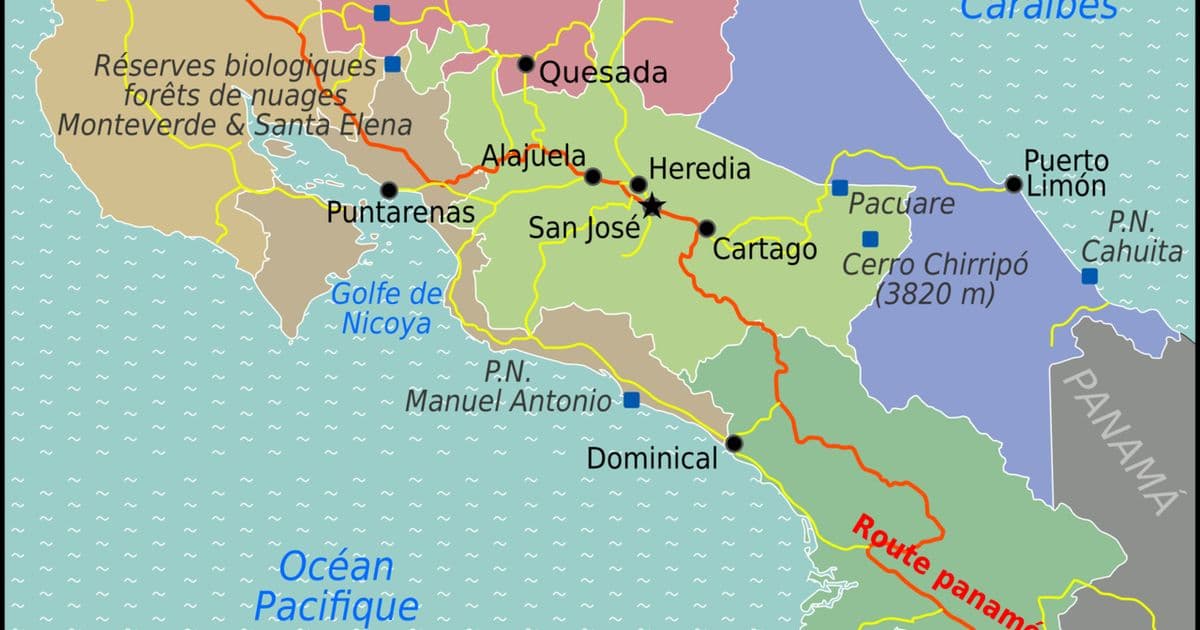
Costa Rica Geography: Complete Guide to the Land and Landscape
Costa Rica occupies a small but geographically extraordinary territory in Central America, covering approximately 51,100 square kilometers — roughly the size of West Virginia. Despite its modest size, the country contains an astonishing variety of landscapes, from Pacific beaches and Caribbean mangroves to active volcanoes and cloud forests exceeding 3,800 meters in elevation. This geographic diversity is the foundation for Costa Rica's exceptional biodiversity and its global reputation as an ecotourism destination.
Location and Size of Costa Rica
Costa Rica is located in Central America, bordered by Nicaragua to the north and Panama to the south. To the west lies the Pacific Ocean, and to the east lies the Caribbean Sea (technically the Caribbean coast of the Atlantic Ocean). The country's latitude ranges from approximately 8°N to 11°N, placing it entirely within the tropics, just north of the equator. This tropical position is fundamental to its climate, biodiversity, and agricultural production.
The country spans approximately 51,100 square kilometers (19,730 square miles) of land area. At its widest point, Costa Rica measures roughly 464 kilometers (288 miles) east to west, while its north-south extent is approximately 274 kilometers (170 miles). The Pacific coastline stretches about 1,016 kilometers (631 miles), while the Caribbean coastline measures approximately 212 kilometers (132 miles). Despite being a small nation by global standards, Costa Rica is home to an estimated 5–6% of the world's total species, reflecting the extraordinary concentration of biodiversity enabled by its geographic position and topographic diversity.
Geographic Coordinates
Costa Rica's geographic center lies at approximately 9°N latitude and 84°W longitude. The capital San José is located at approximately 9°56'N, 84°5'W, sitting in the Central Valley at an elevation of about 1,170 meters (3,840 feet) above sea level. The country's westernmost point is on the Nicoya Peninsula, and its easternmost point borders Panama near the Caribbean coast.
Mountain Ranges and Volcanoes
The backbone of Costa Rica is a series of mountain ranges running roughly northwest to southeast, collectively forming the Cordillera Central and Cordillera de Talamanca systems. These ranges divide the Pacific slope from the Caribbean slope and are responsible for the dramatically different climates experienced on each side of the country.
The Cordillera de Guanacaste in the northwest contains several volcanoes including Rincón de la Vieja (1,916 m), Miravalles (2,028 m), and Tenorio (1,916 m). Moving southeast, the Cordillera de Tilarán includes the Monteverde area, a cloud forest zone of international renown. The Cordillera Central is home to Costa Rica's four most famous volcanoes: Poás (2,708 m), Barva (2,906 m), Irazú (3,432 m — the highest active volcano in Costa Rica), and Turrialba (3,340 m).
The Cordillera de Talamanca in the southeast is the largest and highest mountain range in Central America, with peaks exceeding 3,800 meters. Cerro Chirripó (3,821 m) is the highest point in Costa Rica and the second highest in Central America. The Talamanca range is largely protected within the La Amistad International Park, a UNESCO World Heritage Site shared with Panama. These highland zones experience temperatures well below those at sea level, with frost occasionally occurring above 3,000 meters.
Active Volcanoes
Costa Rica has approximately 112 volcanic structures, of which five are considered active: Poás, Turrialba, Rincón de la Vieja, Miravalles, and Arenal. Arenal was one of the world's most active volcanoes from its 1968 eruption until approximately 2010, when it entered a resting phase. Turrialba has been the most recently active, with significant ash eruptions occurring between 2014 and 2019 that occasionally affected San José and forced temporary closures of Juan Santamaría International Airport.
Cerro Chirripó
Chirripó is Costa Rica's highest peak at 3,821 meters (12,536 feet). The two-day hike to the summit from San Gerardo de Rivas involves a significant elevation gain and requires advance reservation through the SINAC national park system due to strict visitor limits. The summit area features unique páramo vegetation — a high-altitude ecosystem similar to those found in the Andes — and stunning 360-degree views on clear days.
Coasts, Rivers, and Waterways
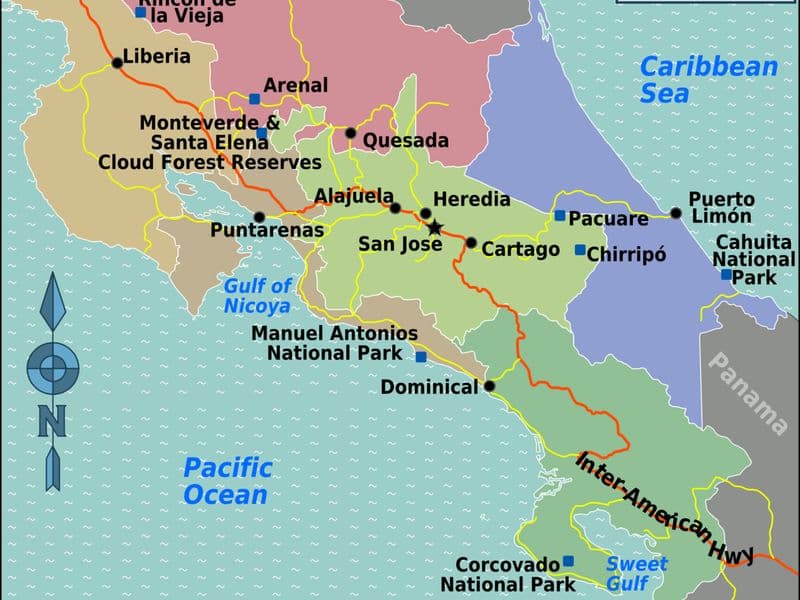
Costa Rica's Pacific coast is characterized by dramatic variation: from the dry, rocky peninsulas and gulf-sheltered bays of the northwest to the lush jungle-backed beaches of the south. The Gulf of Nicoya is a large estuary between the Nicoya Peninsula and the mainland, covering approximately 1,738 square kilometers. Major Pacific rivers including the Tempisque, Río Grande de Térraba, and Río Tárcoles drain westward into the Pacific, creating important estuarine ecosystems.
The Caribbean coast is straighter and lower-lying than the Pacific, backed by extensive coastal lowland rainforests and mangroves. The Tortuguero Canal system — a series of natural lagoons and man-made channels running 100 kilometers (62 miles) along the northern Caribbean coast — is one of the most important wildlife corridors in Central America and provides the only practical access to the remote Tortuguero National Park. Major Caribbean rivers include the Río Pacuare, renowned for world-class white-water rafting, and the Río Reventazón.
Lake Arenal, the country's largest lake at approximately 85 square kilometers, was expanded by a dam in the 1970s and now provides a significant portion of Costa Rica's hydroelectric power. The lake is also a world-renowned windsurfing and kitesurfing destination due to the consistent strong winds funneled by the surrounding mountains, particularly between December and April.
The Osa Peninsula
The Osa Peninsula in the far south of Costa Rica's Pacific coast is one of the most biodiverse regions on Earth and the site of Corcovado National Park. The peninsula juts into the Pacific, creating the Golfo Dulce (Sweet Gulf) on its eastern side — a rare tropical fjord-like embayment with warm, calm waters. The Osa receives some of the highest rainfall in Costa Rica, often exceeding 5,000 millimeters annually.
Climate Zones and Ecosystems
Costa Rica's geographic diversity generates an extraordinary range of climate zones within a compact territory. The tropical lowlands on both coasts experience year-round warmth with temperatures typically between 25°C and 35°C (77°F and 95°F). The Caribbean lowlands receive substantial rainfall year-round, while the Pacific lowlands have a pronounced dry season from December through April. The Central Valley sits at intermediate elevation (800–1,800 meters) and enjoys a spring-like climate year-round, which is why it has historically supported the majority of Costa Rica's human population.
As elevation increases, temperatures drop and rainfall patterns shift. Cloud forests at 1,500–2,500 meters receive their moisture primarily from orographic fog (clouds that form when humid Caribbean air is forced upward over the mountains). At elevations above 3,000 meters, the páramo ecosystem dominates, featuring grasslands and dwarf shrubs adapted to cold temperatures and frost. Costa Rica has been classified as containing between 12 and 14 distinct life zones based on the Holdridge classification system, an extraordinary number for a country of its size.
Tropical Dry Forest
Guanacaste in northwestern Costa Rica contains one of the last remnants of Mesoamerican tropical dry forest, an ecosystem once widespread from Mexico to Panama but now reduced to small isolated patches. This deciduous forest loses most of its leaves during the December–April dry season, creating visually dramatic seasonal changes and concentrating wildlife around remaining water sources. The Guanacaste Conservation Area, a UNESCO World Heritage Site, protects significant tracts of this rare ecosystem.
Cloud Forest and Tropical Rainforest
Cloud forests, found at elevations between 1,500 and 2,500 meters, are perpetually misty ecosystems where trees are draped in epiphytic mosses, orchids, and bromeliads. Monteverde and San Gerardo de Dota are the most accessible cloud forest destinations. Lowland tropical rainforests on the Osa Peninsula, Braulio Carrillo National Park, and the Caribbean slope receive enormous annual rainfall — often 4,000–6,000 millimeters — sustaining the highest biodiversity densities in the country.
Provinces and Regions
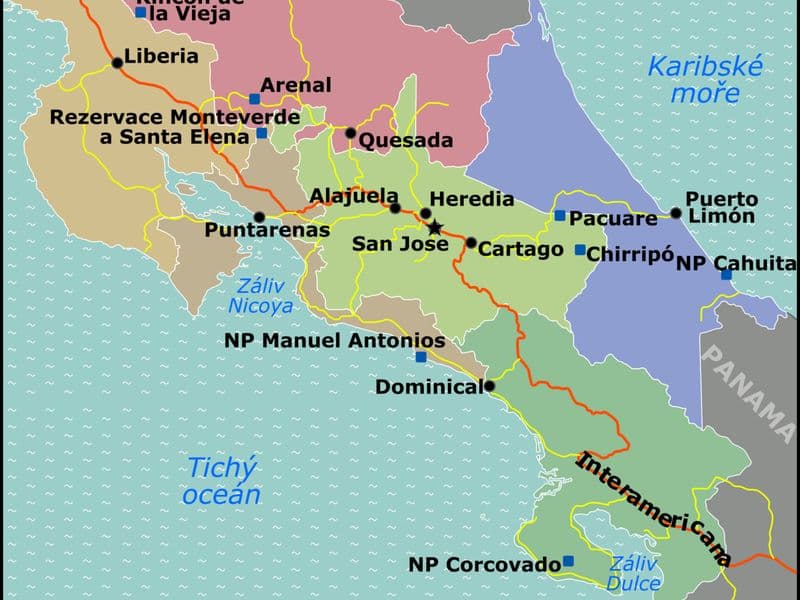
Costa Rica is divided into seven provinces: San José, Alajuela, Cartago, Heredia, Guanacaste, Puntarenas, and Limón. The four central provinces — San José, Alajuela, Cartago, and Heredia — form the densely populated Central Valley region where approximately 60% of the country's 5.2 million people live. San José province contains the capital city and is the country's economic and political center.
Guanacaste Province occupies the northwestern lowlands and is the driest and sunniest region, dominated by cattle ranching, tourism, and some of Costa Rica's most famous beaches. The province is culturally distinct, with strong traditions in music (the punto guanacasteco is Costa Rica's national dance), horsemanship, and oxcart craftsmanship. Puntarenas Province is the largest, stretching from the central Pacific coast down to the Osa Peninsula in the far south. Limón Province covers the entire Caribbean coast and the eastern slopes of the Talamanca mountains, hosting Costa Rica's Afro-Caribbean and Indigenous communities.
The Central Valley
The Meseta Central (Central Valley) is a high-altitude intermontane valley at approximately 1,000–1,500 meters above sea level, running roughly east-west between the Cordillera Central and the Cordillera de Talamanca. The valley's mild climate (average 20–26°C year-round), fertile volcanic soils, and central location made it the center of Spanish colonial settlement and remain the core of modern Costa Rican civilization. San José, Alajuela, Cartago, and Heredia all lie within this valley.
Geology and Tectonic Setting
Costa Rica's dramatic landscape is the direct product of active tectonic processes. The country sits at the convergence of three tectonic plates: the Caribbean Plate, the Cocos Plate (oceanic), and the Nazca Plate. The subduction of the Cocos Plate beneath the Caribbean Plate along the Middle America Trench — a deep ocean trench running parallel to Costa Rica's Pacific coast — drives the country's volcanic activity and frequent earthquakes.
Volcanic activity has built much of Costa Rica's mountainous interior over millions of years, depositing rich volcanic soils that support the country's highly productive agriculture, particularly coffee cultivation in the Central Valley. The Cocos Ridge, an oceanic feature on the Cocos Plate, is subducting beneath Costa Rica's Pacific coast and is thought to contribute to the uplift of the Talamanca mountain range. Cocos Island, a Costa Rican territory located 550 kilometers offshore in the Pacific, sits on this same ridge.
Earthquakes are common throughout Costa Rica, with major events periodically affecting urban areas. The 1991 Cobán earthquake (magnitude 7.6) significantly altered the Caribbean coastline near Limón and caused substantial infrastructure damage. Costa Rica maintains a robust national network of seismological monitoring stations and has implemented strict earthquake-resistant building codes in urban areas.
Cocos Island
Cocos Island (Isla del Coco) is a remote Costa Rican territory located 550 kilometers southwest of the mainland in the Pacific Ocean. The island is the only oceanic island in the Eastern Pacific with a tropical rainforest and is famous for exceptional scuba diving, particularly for schooling hammerhead sharks, manta rays, and whale sharks. It is protected as a national park and UNESCO World Heritage Site and is accessible only by live-aboard dive boats requiring a multi-day journey from Puntarenas.
Biodiversity and Conservation Geography
Costa Rica's geographic position at the junction of North and South America, combined with its two coastlines and dramatic elevational variation, has made it a hotspot for biological diversity. The country protects approximately 25–27% of its national territory in a network of national parks, biological reserves, wildlife refuges, and protected zones — one of the highest percentages of protected land of any country in the world.
The national park system, administered by SINAC (Sistema Nacional de Áreas de Conservación), is organized into 11 conservation areas covering all major ecosystems. Key parks include Corcovado (considered one of the world's most biologically intense areas by National Geographic), Manuel Antonio, Arenal Volcano, Monteverde Cloud Forest Reserve (private reserve), Tortuguero, and Cahuita on the Caribbean coast. Two Costa Rican properties are designated UNESCO World Heritage Sites: the Guanacaste Conservation Area and the Talamanca Range-La Amistad Reserves/La Amistad National Park.
Private nature reserves complement the national park system, with many of Costa Rica's most famous ecotourism destinations — including Monteverde and the Osa Peninsula lodges — operating on private conservation land. Biological corridors connecting protected areas are a key conservation priority, allowing wildlife populations to move between fragmented habitat patches across an increasingly developed landscape.
Biodiversity Statistics
Costa Rica contains approximately 500,000 species — an estimated 5% of all species on Earth — in a country that represents less than 0.03% of the planet's land surface. The country hosts over 900 species of birds, 225 species of reptiles, 186 amphibian species, 232 mammal species, and over 9,000 vascular plant species. Around 1,200 species of orchids alone have been recorded, and the number of insect species is estimated in the hundreds of thousands.
Frequently Asked Questions
Where is Costa Rica located geographically?
Costa Rica is located in Central America between Nicaragua (to the north) and Panama (to the south). It borders the Pacific Ocean on its west coast and the Caribbean Sea on its east coast, sitting entirely within the tropics at approximately 8°N to 11°N latitude.
What is the highest mountain in Costa Rica?
Cerro Chirripó is the highest point in Costa Rica at 3,821 meters (12,536 feet) above sea level. It is located in the Cordillera de Talamanca in the southern part of the country and is accessible via a challenging two-day hike from San Gerardo de Rivas, requiring advance reservations through the national park system.
How many volcanoes does Costa Rica have?
Costa Rica has approximately 112 volcanic structures, of which five are classified as currently active: Poás, Turrialba, Rincón de la Vieja, Miravalles, and Arenal. Turrialba has been the most recently active with ash eruptions between 2014 and 2019. Arenal is in a resting phase since approximately 2010 but remains a major tourist attraction.
What percentage of Costa Rica is protected land?
Approximately 25–27% of Costa Rica's national territory is protected in national parks, biological reserves, wildlife refuges, and protected zones — one of the highest proportions of protected land of any country globally. This extensive conservation network is the foundation of the country's ecotourism industry.
What are the main geographic regions of Costa Rica?
Costa Rica's main geographic regions include: the North Pacific coast (Guanacaste and the Nicoya Peninsula), the Central Pacific coast, the South Pacific coast (including the Osa Peninsula), the Central Valley (Meseta Central), the Caribbean lowlands, the Central volcanic mountain range (Cordillera Central), and the Talamanca highlands in the south.