Costa Rica Official Language: Spanish, Its Legal Status, and Linguistic Diversity
Spanish is the official language of Costa Rica, enshrined in the country's constitution and used in all government functions, public education, law, and formal communication. Costa Rican Spanish has distinctive regional characteristics — including the pervasive use of the formal 'usted' and a rich vocabulary of local slang known as Tiquismo — that set it apart from Spanish spoken elsewhere in Latin America. The country's linguistic landscape is enriched by indigenous languages, Caribbean Creole English, and widespread English instruction.
Constitutional Status of Spanish in Costa Rica
Spanish (español or castellano) holds the status of Costa Rica's official national language under the country's 1949 Constitution, making it the exclusive language of government, law, courts, public administration, and formal education. All official documents — legislation, judicial decisions, government forms, public contracts, and regulations — are issued in Spanish, and legal proceedings are conducted in Spanish with translation services available for those who require them.
The constitutional designation of Spanish as the official language reflects the historical reality of colonial settlement and the dominance of the Spanish-speaking mestizo population since the 17th century. Unlike some multilingual nations that have multiple official languages, Costa Rica has a single official language, which has contributed to linguistic cohesion across its territory despite significant regional cultural variation.
The official status of Spanish does not mean that other languages lack legal recognition. Costa Rica's Constitution and subsequent legislation guarantee the cultural and linguistic rights of indigenous peoples, and international conventions including ILO Convention 169 (which Costa Rica has ratified) commit the government to supporting indigenous language maintenance and bilingual intercultural education in indigenous territories. The Caribbean Creole English (Mekatelyu) of Limón province has informal social recognition but no official legal status.
The 1949 Constitution and Language
Costa Rica's 1949 Constitution — drafted after the 1948 Civil War and still in force today — established Spanish as the official language within a broader framework of democratic rights and institutions. The constitution also established the principles of universal education, free primary schooling, and compulsory attendance that have driven the country's high literacy rates. The language provisions of the constitution reflect both practical necessity and an assertion of national cultural identity distinct from other Central American countries.
Characteristics of Costa Rican Spanish
Costa Rican Spanish is a variety of Central American Spanish with several distinctive features that linguists and visitors notice immediately. The most fundamental characteristic is phonological: Costa Rican Spanish preserves the final 's' at the end of syllables clearly, rather than aspirating or dropping it as occurs in Caribbean and some South American dialects. This gives the speech a crisp, clear quality that many Spanish language learners find easier to understand than other regional varieties.
Intonation patterns in Costa Rican Spanish have a characteristic melodic quality that distinguishes it from neighboring Central American countries. Costa Rican speech has a slightly higher average pitch range than, for example, Nicaraguan or Salvadoran Spanish, giving it what linguists describe as a "musical" quality. Costa Ricans sometimes jokingly acknowledge that people from other countries can identify a Tico by the intonation pattern alone, even before any specific vocabulary is used.
Vocabulary is where Costa Rican Spanish diverges most dramatically from standard Latin American Spanish. The collection of distinctly Costa Rican words and expressions — known collectively as Tiquismo — includes unique words like "mae" (dude), "chunche" (thing/thingamajig), "diay" (well/you see), "tuanis" (cool, from English "too nice"), and the ubiquitous "pura vida" (pure life — used as greeting, farewell, affirmation, and response to "how are you?"). These terms are not understood in the same way outside Costa Rica and mark speakers immediately as Ticos.
Phonological Clarity
Costa Rican Spanish's clear articulation of consonants, particularly the final 's' and intervocalic consonants that are weakened or dropped in many other Spanish varieties, makes it one of the more legible varieties for language learners. Spanish language schools often advertise this feature as an advantage of studying in Costa Rica versus other destinations. The clear pronunciation is partly attributed to the relatively isolated colonial history of the Central Valley, where contact with African and indigenous substrate languages that often affect consonant pronunciation was limited compared to coastal colonial centers.
The 'Usted' Culture: Formal Spanish in Casual Contexts
One of the most studied and discussed features of Costa Rican Spanish is the pervasive use of "usted" — the formal second-person singular pronoun — in contexts where speakers of most other Spanish varieties would use "tú" (informal) or "vos" (in voseo-using countries). In Costa Rica, "usted" is used with friends, family members, romantic partners, children, and even pets, creating a linguistic register that appears paradoxically formal to outsiders but is entirely natural and intimate within Costa Rican cultural norms.
This phenomenon is called "el ustedeo" and is the subject of considerable academic linguistic interest. The verb forms associated with "usted" (third person singular) are used throughout these intimate interactions: a mother says to her toddler "¿Cómo está usted?" (How are you?) rather than the "¿Cómo estás?" that would be used in Mexican or Spanish Spanish. Husbands and wives commonly use "usted" throughout long marriages. This pattern has no parallel in any other Spanish-speaking country at the same level of pervasiveness.
Costa Rica also uses "vos" (the second-person singular pronoun common in Argentina, Uruguay, and parts of Central America) in some registers, particularly among younger speakers and in casual contexts between peers. However, even "vos" is used less extensively in Costa Rica than "usted," and "tú" — standard in Spain and dominant in Mexico — is rarely used and can sound foreign or affected in colloquial Costa Rican speech. The coexistence of "usted" and "vos" with different social meanings creates a pronoun system more complex than in most Spanish-speaking countries.
Cultural Origins of Ustedeo
Linguists and anthropologists have proposed several explanations for Costa Rica's uniquely pervasive "ustedeo." Some trace it to the colonial history of a relatively isolated settler population that maintained formal speech patterns from 17th-century Spanish without the linguistic evolution that occurred in more cosmopolitan colonial centers. Others connect it to a deep cultural value of respect and courtesy (respeto) that pervades all Costa Rican social relationships regardless of hierarchy. Whatever its origin, the "ustedeo" is one of the most distinctive and defining features of Costa Rican linguistic identity and is immediately noticed by Spanish speakers from other countries.
Indigenous Languages and Legal Protections
Costa Rica is home to eight recognized indigenous peoples whose ancestral languages form part of the national linguistic heritage, even as these languages face serious endangerment. The recognized indigenous languages are: Bribri (spoken by approximately 11,000 people in the Talamanca region), Cabécar (closely related to Bribri, spoken in the Talamanca mountains), Brunca/Boruca (spoken by the Brunca people of the Southern Pacific), Ngäbe (spoken by the Ngäbe who straddle the Costa Rica-Panama border), Buglé, Térraba (Teribe), Maleku (northern lowlands), and Huetar (Central Valley region). All are considered endangered, with Maleku, Huetar, and Térraba critically so.
The legal framework for indigenous language protection includes the 1977 Indigenous Law (Ley Indígena), the 1994 Law for the Development of Indigenous Communities, and ILO Convention 169 on Indigenous and Tribal Peoples, which Costa Rica ratified in 1993. These instruments commit the state to supporting cultural and linguistic rights, including bilingual intercultural education in indigenous territories. In practice, the Ministry of Public Education (MEP) administers a bilingual education system in some indigenous territories, with Bribri receiving the most resources and the strongest formal educational support.
Academic research on Costa Rican indigenous languages is conducted primarily at the Universidad de Costa Rica (UCR) and the Universidad Nacional (UNA), where linguists work on documentation, grammar description, and language revitalization projects. Digital archives of indigenous language recordings, dictionaries, and teaching materials have been developed to support both language learning and archival preservation. Community-based revitalization efforts, led by indigenous language activists, seek to increase intergenerational transmission through language nests, cultural programs, and media in indigenous languages.
Bribri: The Most Vital Indigenous Language
Bribri is the most widely spoken and most robustly documented indigenous language in Costa Rica, with an estimated 11,000 speakers in the Talamanca Bribri and Talamanca Cabécar indigenous territories on the Caribbean slope. The language is notable for its complex tonal system (pitch affects meaning), its use of evidential markers that distinguish firsthand from reported information grammatically, and its matrilineal clan structure encoded in social vocabulary. Bribri is taught in some schools within indigenous territories, and the language has a published grammar, dictionary, and growing educational materials developed through university-community partnerships.
English as a Secondary Language
English is the most widely spoken foreign language in Costa Rica and occupies a unique position in the national linguistic landscape. It is the primary language of international tourism — the country's largest industry — and is increasingly used in the growing technology and services export sector centered in San José. English proficiency is a valued and economically rewarded skill in the formal labor market, particularly in call centers, technology companies, and tourism-related businesses.
Despite its economic importance, English is not an official language in Costa Rica. Its status is that of a widely taught and economically significant foreign language rather than a co-official language. Instruction in English is mandated in public schools from primary level onward under the national curriculum, but the quality and outcomes of public school English instruction vary enormously between well-resourced urban schools and rural or marginalized communities with limited qualified teaching staff.
In major tourist destinations — Tamarindo, Manuel Antonio, La Fortuna, and the tourist areas of San José — English is widely spoken and visitors can navigate comfortably without Spanish. In rural areas, smaller towns, and working-class urban neighborhoods, Spanish is necessary for basic communication, and English speakers may find little support. This geographic distribution of English proficiency means that visitors who venture beyond the tourist circuit will benefit significantly from even basic Spanish ability.
The Call Center Economy and English
Costa Rica has become a major center for multinational call center and business process outsourcing (BPO) operations, drawn by the country's relatively high English proficiency, educated workforce, and stable political environment. Companies including Amazon, Sykes, Convergys, and many others operate large call center facilities in the San José metropolitan area, employing tens of thousands of bilingual Costa Ricans. This sector has created significant economic demand for English language skills and influenced public investment in English education throughout the educational system.
Language Policy and Education
Costa Rica's approach to language in education reflects its broad commitment to public schooling as a national priority. The Ministry of Public Education (MEP) sets national curriculum standards that require English instruction beginning in the first year of primary school, with the goal of developing functional bilingualism in the population for economic competitiveness in a globalized economy. The National English Program (Programa Nacional de Inglés) has been a focus of education reform, with ongoing efforts to improve teacher qualification and teaching methodology.
The reality of language education in Costa Rica is a tale of significant inequality. Elite private schools, many of which are bilingual institutions teaching in both Spanish and English, produce graduates with near-native English proficiency. Well-funded public schools in San José and tourist areas achieve functional bilingualism for many students. Rural and lower-income urban schools often have poorly resourced English programs with underqualified teachers and inadequate materials, perpetuating economic disadvantage by limiting students' access to English-required employment.
Higher education in Costa Rica is offered primarily in Spanish at public universities (UCR, UNA, TEC, UNED) and private institutions. International programs and graduate degrees increasingly offer coursework in English, and some universities have established partnerships with U.S. and European institutions that require English proficiency. The Center for Language Learning (CENL) at UCR is the primary institution for university-level Spanish instruction for foreign students and has been a reference point for teaching Spanish as a foreign language throughout the country.
Spanish Language Schools for Foreigners
Costa Rica has a substantial industry of Spanish language schools catering to international students who come specifically to learn or improve their Spanish in an immersive environment. Schools are concentrated in San José, Heredia, Alajuela, Tamarindo, La Fortuna, and other tourist areas, offering programs ranging from intensive weekly courses to semester-long academic programs. The combination of clear Costa Rican Spanish pronunciation, a welcoming culture, and diverse tourism experiences makes the country an appealing Spanish learning destination, and many schools offer homestay arrangements with Costa Rican families to maximize language immersion.
Linguistic Diversity on the Caribbean Coast
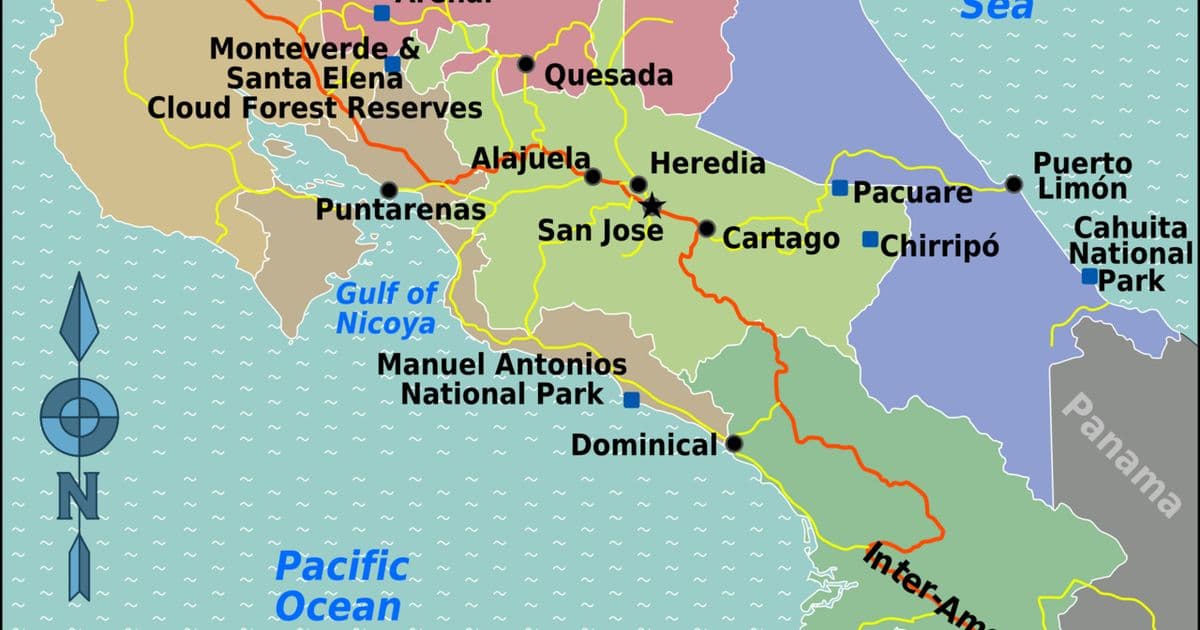
The Caribbean province of Limón represents Costa Rica's most linguistically distinctive region, where the Afro-Costa Rican community maintains Mekatelyu (Limonese Creole English) as a living heritage language alongside Spanish. Mekatelyu — the name derives from the English phrase "make I tell you" — is a Creole language that developed among the Jamaican immigrant community that arrived in the late 19th century to build the Atlantic Railroad and work on banana plantations.
Mekatelyu is not simply accented English but a distinct linguistic system with its own grammar, pronunciation patterns, vocabulary, and idiomatic expressions. Its lexical base is primarily English, but its grammar shows influences from West African languages brought through Jamaican Creole, as well as some Spanish contact influence from generations of bilingualism. The language is an oral tradition — it has rarely been formally written or taught in schools — and faces challenges of transmission to younger generations who are often more fluent in Spanish than in Mekatelyu.
The indigenous peoples of the Caribbean slope — primarily Bribri and Cabécar — add further linguistic complexity to the Limón region, creating a multilingual environment where Spanish, Mekatelyu, Bribri, and Cabécar may all be encountered within a relatively small geographic area. This multilingual character of the Caribbean coast reflects its history as a culturally distinct region that was integrated into the Costa Rican national mainstream much later than the Central Valley and Pacific regions.
Mekatelyu: A Living Language Under Threat
Mekatelyu is considered a threatened language, with younger generations in Limón increasingly shifting to Spanish as their primary language in response to educational, economic, and social pressures that favor Spanish proficiency. Community organizations, academics, and cultural activists are working to document and revitalize Mekatelyu through recordings, community events, and advocacy for its recognition in educational contexts. The language carries the cultural memory of the Afro-Caribbean community's history in Costa Rica and is considered a critical part of the national cultural heritage by scholars and community advocates, even as its number of fluent speakers declines with each generation.
Frequently Asked Questions
What is the official language of Costa Rica?
Spanish is the official language of Costa Rica, designated by the 1949 Constitution and used exclusively in government, law, public education, and formal administration. All official documents and legal proceedings are conducted in Spanish.
Do Costa Ricans speak English?
English proficiency varies widely. In major tourist areas, hotels, and the technology sector, English is widely spoken. In rural areas and among older generations, Spanish is essential. English is taught in public schools from primary level, but outcomes are uneven, with private schools producing much higher proficiency than many public schools.
What makes Costa Rican Spanish unique?
Costa Rican Spanish is distinctive for its clear pronunciation (final 's' preserved), the pervasive use of 'usted' even with close friends and family, a unique local slang vocabulary (Tiquismo) including words like 'mae,' 'diay,' 'tuanis,' and 'pura vida,' and a characteristic musical intonation pattern that makes Ticos recognizable to other Spanish speakers.
Are there indigenous languages in Costa Rica?
Yes. Costa Rica has eight recognized indigenous languages: Bribri, Cabécar, Brunca/Boruca, Ngäbe, Buglé, Térraba, Maleku, and Huetar. All are considered endangered. Bribri, with approximately 11,000 speakers in the Talamanca region, is the most widely spoken. The government provides some bilingual education in indigenous territories, and academic preservation efforts are ongoing.
What is Mekatelyu?
Mekatelyu (also called Limonese Creole English or Caribbean Creole) is the Creole language spoken by the Afro-Caribbean community of Costa Rica's Limón province. It developed among Jamaican immigrants who came to Costa Rica in the late 19th century. Mekatelyu has an English lexical base with West African grammatical influences and is distinct from standard English, though it shares many words.