
Costa Rica Quetzal Bird: Biology, Habitat, and the Best Places to See One
The resplendent quetzal is perhaps the most visually striking bird on Earth, and Costa Rica's cloud forests are among the most reliable places to witness this extraordinary creature in the wild. With its shimmering emerald body, crimson belly, and impossibly long tail plumes that trail behind a breeding male in flight, the quetzal occupies a unique place in both natural history and human culture — sacred to ancient Mesoamerican civilizations and endlessly sought by modern birdwatchers from around the world. Understanding the biology and ecology of the Costa Rica quetzal bird transforms a chance encounter into a deeply meaningful wildlife experience.
Quetzal Bird Biology: Size, Plumage, and Lifespan
The resplendent quetzal (Pharomachrus mocinno) belongs to the trogon family — a pantropical group of forest birds characterized by their upright posture, heterodactyl feet (with two toes pointing forward and two backward), and habit of sitting motionless for long periods before making short flights to capture food. Within the trogon family, the quetzals of the genus Pharomachrus are the most spectacular, and the resplendent quetzal is the largest and most ornate of the five quetzal species found from Mexico to Bolivia.
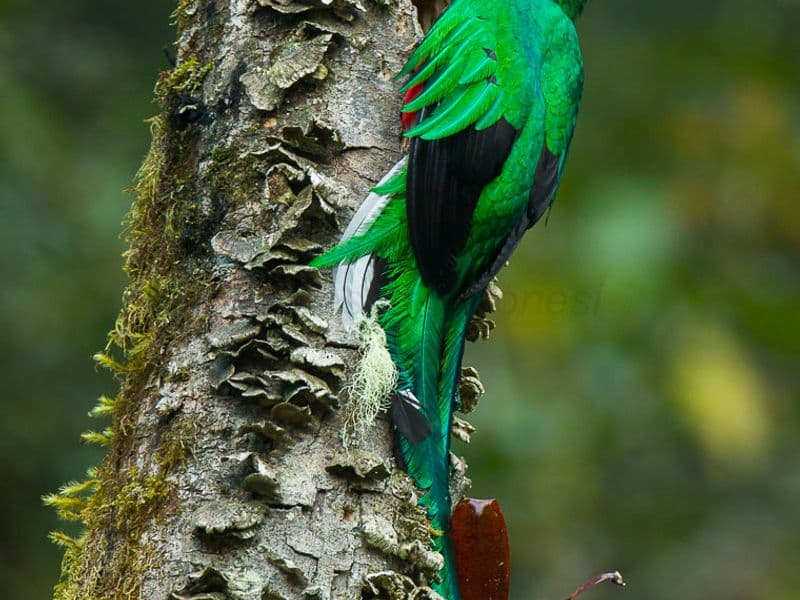
Adult male quetzals measure approximately 36 to 40 centimeters in body length, with the extraordinary upper tail covert feathers adding another 60 to 100 centimeters during breeding season. The iridescent coloration of the plumage results from nanostructures in the feather barbules that refract light into brilliant greens and blues — a structural color rather than a chemical pigment. This is why the bird's color appears to shift and flash as it moves or as the observer changes viewing angle. The head bears a rounded, brush-like crest of fine filamentous feathers. The bill is yellow in males and tends toward darker tones in females.
Females are considerably less ornate. They share the green body coloration but have a gray-brown head, a tail barred with black and white rather than the uniform deep green of the male's rectrices, and a red belly less vivid than the male's crimson. Young birds resemble females until they develop adult plumage. The lifespan of wild quetzals is estimated at 20 to 25 years based on observations of banded individuals, though survival rates in wild populations are subject to the many mortality risks of cloud forest life including predation, competition for nesting sites, and the physical demands of migration and breeding.
The Tail Feathers: Nature's Most Spectacular Plumes
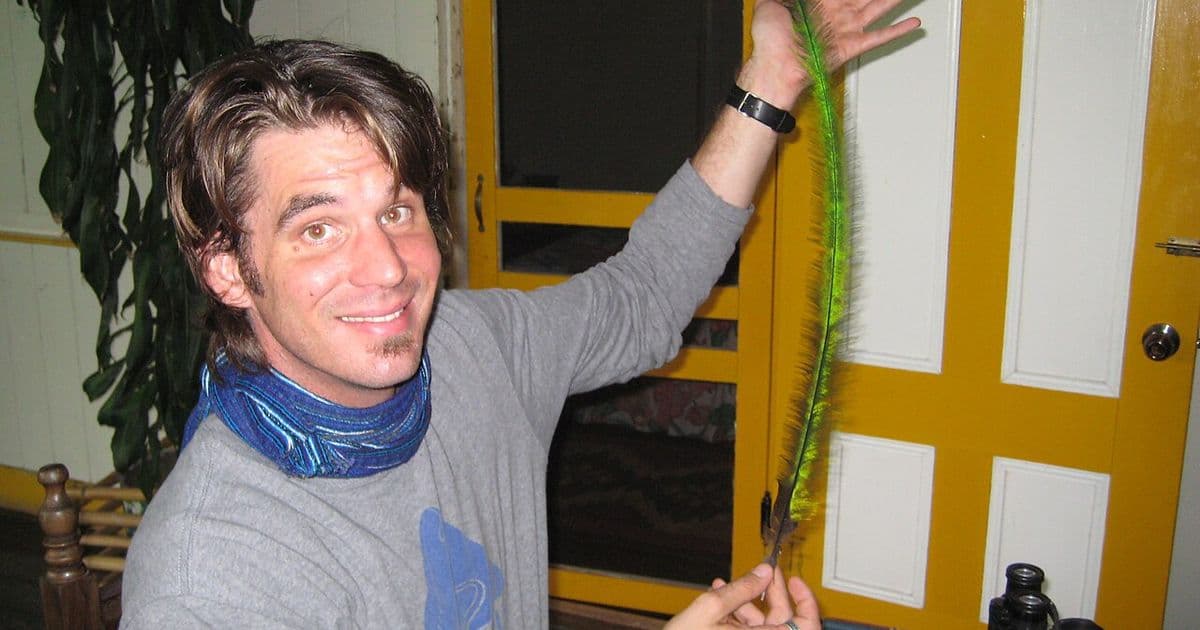
The male quetzal's upper tail covert feathers — the 'tail plumes' that trail dramatically behind the bird in flight and display — are not technically tail feathers at all, but elongated covert feathers that overhang the actual tail. These plumes grow during the dry season breeding period and are shed after the breeding season concludes, so males without plumes outside of breeding season can look quite different from their spectacular breeding-season appearance. The plumes can reach 100 centimeters — making the total length of a fully plumed male quetzal approximately 130 to 140 centimeters from bill tip to plume tip, despite a body that weighs only around 200 grams.
Where Quetzals Live in Costa Rica
Quetzals in Costa Rica are restricted to cloud forest ecosystems at elevations between approximately 1,500 and 3,000 meters. This altitude band corresponds to the zone of persistent cloud and fog formation on Costa Rica's three main mountain ranges — the Tilarán (Monteverde area), the Central Volcanic Range (Poás, Barva, Irazú), and the Talamanca Range (Chirripó, La Amistad). The cloud forest environment is characterized by cool temperatures (typically 10–18°C at quetzal elevations), near-constant high humidity, and the presence of large amounts of epiphytic vegetation — mosses, orchids, bromeliads, and ferns — that drape every surface of the forest.
Within the cloud forest, quetzals are most closely associated with primary forest that contains large, mature trees of the laurel family (Lauraceae). These include wild avocado trees of the genera Ocotea, Nectandra, and Persea, which produce the small fruits that form the core of the quetzal's diet. The availability and current fruiting status of these trees largely determines where individual quetzals are found at any given time of year. In areas where logging or agricultural conversion has removed mature laurel trees, quetzal density is typically much lower even when other cloud forest vegetation has recovered.
Quetzals undertake seasonal altitudinal movements — sometimes called 'altitudinal migration' — in response to shifts in fruit availability across the elevation gradient. During the dry season breeding period (January to May), they concentrate at higher elevations where primary forest and fruiting trees are most abundant. As the wet season progresses and fruiting trees at lower elevations enter production, individual birds may move down several hundred meters in elevation to follow food resources. These movements can bring quetzals into areas of secondary forest and shade-grown coffee plantations below the usual cloud forest zone, creating unexpected sighting opportunities in transitional habitat.
Cloud Forest Zones: Monteverde vs. Talamanca
Costa Rica's two primary quetzal-watching regions have different characteristics. The Monteverde cloud forest on the Tilarán Range is at a lower elevation (approximately 1,400–1,800 m at the main reserves) and has a slightly warmer, more accessible character, with better-developed tourism infrastructure. The Talamanca Range destinations — particularly San Gerardo de Dota at 2,100–2,600 m — have colder, wilder cloud forest and are considered superior for quetzal density and reliability of sightings by experienced birders. For visitors who can make the journey to Dota, the more remote setting is well worth the extra effort.
Quetzal Nesting and Breeding Behavior
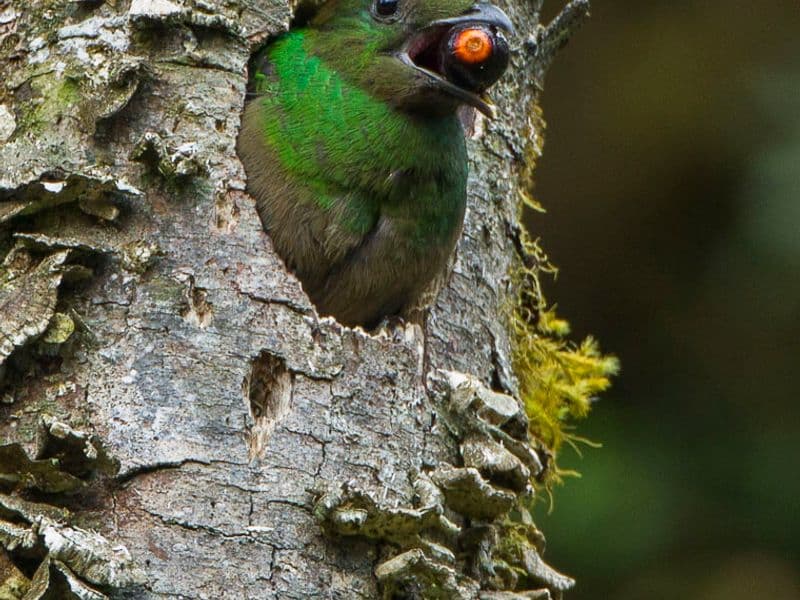
Quetzal nesting begins during the dry season in Costa Rica, typically from January or February. Both sexes cooperate in excavating or enlarging a nest cavity in a soft, decaying tree trunk or stump. The birds use their strong beaks to gouge a horizontal entrance tunnel that opens into a vertical cavity chamber. Nest trees are typically 5 to 30 meters tall, and the nest entrance hole is usually 6 to 8 centimeters in diameter — just large enough for the bird to enter while perching, though the male's tail plumes must be carefully folded outside when he is inside the cavity.
Clutch size is typically two eggs, pale blue-green in color. Incubation lasts approximately 18 days, shared by both parents in alternating shifts — the female incubates overnight and in the early morning, the male takes over during the middle part of the day. Chicks hatch altricial (helpless and requiring parental care) and are brooded and fed by both parents. The young birds fledge at approximately 23 to 30 days of age. After fledging, family groups may remain loosely associated for a period before the juveniles become independent. Successful pairs often return to the same nesting tree in subsequent years.
The male quetzal performs elaborate aerial display flights during courtship and territorial defense. These flights, which carry the male 30 to 50 meters above the forest canopy, show the full length of the tail plumes as they undulate and trail behind the rapidly flying bird. The display flight is accompanied by characteristic calling and often ends with a steep dive back into the canopy. When two male quetzals engage in territorial boundary disputes, both may engage in simultaneous display flights with chasing behavior, creating one of the most dramatic wildlife spectacles available in Costa Rica's cloud forests during the breeding season.
Nest Site Selection and Cavity Competition
The availability of suitable nesting trees is a significant limiting factor for quetzal populations. Large-diameter decaying trees with appropriately soft wood for excavation are less common in managed or secondary forest, creating a potential nest site shortage. Quetzals face competition for existing cavities from other cavity-nesting species, including various trogon species, woodpeckers, and several mammal species. In some cloud forest areas, the installation of artificial nest boxes has been trialed as a supplemental nesting resource, with mixed success. The protection of large decaying trees — 'snags' — within cloud forest reserves is an important management consideration for quetzal conservation.
What Quetzals Eat: The Wild Avocado Connection
The quetzal's diet is one of the most specialized among Costa Rica's bird species. Fruit — particularly the small, avocado-like fruits of laurel family trees — comprises approximately 80% of the diet by volume. The quetzal swallows these fruits whole, with the large seed passing through the digestive system and being dispersed far from the parent tree in the bird's droppings. This makes quetzals one of the most ecologically important seed dispersers in Costa Rica's cloud forest ecosystem — without quetzal dispersal, many laurel species would have significantly reduced seed dispersal distances and regeneration rates.
The mutualistic relationship between quetzals and wild avocado trees represents one of the most elegant coevolutionary partnerships in the neotropical rainforest. The trees produce nutrient-rich, oily fruits of a size precisely calibrated to be swallowed by a quetzal but too large for most smaller birds to consume whole. The quetzal benefits from the high-fat, high-energy fruit, while the tree benefits from having its seeds carried far from the parent — reducing competition between seedlings and colonizing new sites across the forest landscape. The loss of either quetzals or laurel trees from a cloud forest ecosystem has cascading consequences for the regeneration of the other.
Beyond fruits, quetzals supplement their diet with insects, lizards, frogs, and small snails, particularly when feeding nestlings that require high-protein food for rapid growth. Parents bringing food to a nest will alternate between fruit deliveries and small animal prey throughout the day. Insects are captured in characteristic trogon-style sallying flights — the bird launches from a perch, snatches an insect from a leaf surface or from the air, and returns to a perch to consume the prey. Lizards and frogs captured on the forest floor are carried back to the nest and delivered headfirst to chicks.
Fruiting Trees and Quetzal Tracking
Local guides in San Gerardo de Dota and Monteverde track the fruiting status of known quetzal food trees as a key tool for locating birds reliably. When a particular Ocotea or Nectandra tree enters heavy fruiting, quetzals will visit repeatedly throughout the day to feed, creating dependable observation windows. Guides who have worked the same forest for years know which trees produce fruit in which season and can position visitors near actively productive trees for extended, high-quality observation. This traditional ecological knowledge — passed between generations of local guide families — is one of the most valuable assets in quetzal ecotourism.
Best Sites and Guided Tours for Quetzal Watching
The Savegre Hotel Natural Reserve and Spa in San Gerardo de Dota is one of the most renowned quetzal-watching lodges in the world. The hotel, run by the Chacón family for several generations, manages a private forest reserve of hundreds of hectares of primary cloud forest where quetzals have been monitored and studied for decades. Guided quetzal walks depart at dawn, with the best results occurring in the first two hours after sunrise when birds are actively feeding and calling. The hotel's resident guide team maintains an encyclopedic knowledge of current quetzal locations within the reserve and has an extraordinary track record of successful sightings for visiting guests.
Birding tours specifically targeting quetzals are offered by several specialist operators in Costa Rica. Horizontes Nature Tours, Costa Rica Birding, and Expediciones Tropicales are among the most established operators running day trips and multi-day itineraries that include San Gerardo de Dota as the quetzal centerpiece. These tours combine the quetzal experience with other highland birding specialties including fiery-throated hummingbirds, volcano juncos, and black-and-yellow silky-flycatchers, making efficient use of the travel time to the Talamanca highlands.
Independent visitors to San Gerardo de Dota can arrange guided walks directly through lodges in the valley rather than pre-booking through a tour operator. The main road into the valley from the Pan-American Highway descends steeply for approximately 9 kilometers from the highway junction to the valley floor — a rental car with good brakes and a confident driver is recommended. Several small family lodges and guesthouses in the valley in addition to the Savegre Hotel offer accommodation and guiding services. Arriving the previous evening, sleeping in the valley, and beginning the guided walk at dawn maximizes the quetzal-watching opportunity and avoids the long predawn drive from San José.
Peñas Blancas Valley and Caribbean Slope Quetzals
The Peñas Blancas valley descending from the Monteverde highlands toward the Caribbean drainage is a less-visited but productive quetzal area during the wet season when birds make their altitudinal descent. The Children's Eternal Rainforest — the largest private reserve in Costa Rica — borders this valley and shelters quetzals and other cloud forest species in an area managed by the Monteverde Conservation League. Guided walks into the Peñas Blancas area can be arranged through the Monteverde Conservation League and offer a less-trafficked alternative to the main Monteverde Reserve during peak visitor season.
Quetzal Bird Conservation in Costa Rica
The resplendent quetzal is protected by Costa Rican law and by international agreements including CITES (Convention on International Trade in Endangered Species), which prohibits commercial trade in the species or its feathers. Within Costa Rica, the primary conservation challenge is not direct persecution but habitat protection and connectivity — ensuring that the cloud forest areas where quetzals breed, feed, and migrate remain intact, connected, and managed for long-term ecological integrity.
The Monteverde Conservation League has been central to cloud forest conservation in the Tilarán Range for over four decades, purchasing and managing forest land for conservation since the 1970s. The league manages the Children's Eternal Rainforest (Bosque Eterno de los Niños) — so named because it was funded partly by children in Scandinavian schools who raised money to buy rainforest — as one of the largest private reserves in Central America. This reserve provides a crucial buffer around the government-managed Monteverde and Santa Elena reserves and is managed specifically to maintain connectivity for wide-ranging species including quetzals.
Climate change monitoring in Costa Rica's cloud forests uses quetzal distribution as one indicator of ecological change. If warming temperatures force cloud formation to higher elevations, the available habitat for quetzals and their food trees will be reduced as the cloud forest zone is compressed against mountain summits. Long-term monitoring programs at San Gerardo de Dota and Monteverde document quetzal breeding success and seasonal movements as baselines for detecting future change. Costa Rica's well-developed protected area network provides resilience for quetzal populations compared to countries where cloud forest conservation has been less successful, but the combination of climate change and continued land use pressure on areas outside parks remains a significant long-term concern.
Ecotourism as a Conservation Tool for Quetzals
The economic value of quetzal tourism in San Gerardo de Dota, Monteverde, and other cloud forest destinations has become a powerful conservation argument for protecting cloud forest on private land. Local families who have built their livelihoods around quetzal guiding and eco-lodge accommodation have a direct economic interest in maintaining intact forest on their properties. The Chacón family's Savegre Hotel in Dota is a well-known example of how quetzal tourism can generate sufficient income to make forest conservation economically competitive with alternative land uses such as farming or cattle ranching. This model of economic incentivization of conservation through wildlife-based tourism has influenced conservation policy both within Costa Rica and internationally.
Frequently Asked Questions
What does a quetzal look like?
A male resplendent quetzal has an iridescent emerald-green head and upper body, a brilliant crimson belly, and during breeding season, spectacular green tail plumes extending up to 100 centimeters behind the body. The head bears a rounded crest of filamentous feathers and the bill is yellow. The female has similar green body coloring but a gray-brown head, a barred tail, and a less vivid belly. Both sexes have the upright, motionless posture characteristic of the trogon family.
Is the quetzal bird rare?
The quetzal is classified as Near Threatened by the IUCN due to ongoing cloud forest habitat loss across its range. Within Costa Rica, where cloud forest is better protected than in some other parts of its range, the species is relatively secure but restricted to cloud forest above 1,500 meters. At good sites with expert guides, quetzal sightings are reliable during the breeding season — making it one of the most accessible 'threatened' bird species for visitors to see in the wild.
Can you see quetzals near San José, Costa Rica?
Yes — San Gerardo de Dota, the premier quetzal watching destination, is approximately 2 to 2.5 hours by road from San José via the Pan-American Highway. It can be visited as a day trip from San José, though an overnight stay at the valley lodges is strongly recommended to allow a dawn guided walk, which provides the best quetzal observation. Braulio Carrillo National Park, closer to San José at about 30 minutes, occasionally has quetzals in its upper elevation sections but is significantly less reliable.
How much does a quetzal birdwatching tour cost in Costa Rica?
Guided quetzal walks at lodges in San Gerardo de Dota typically cost $25 to $50 USD per person for a 2 to 3 hour guided morning walk, not including accommodation. Full-day tours from San José including transport, a bilingual guide, and the morning quetzal walk cost approximately $100 to $180 USD per person through established tour operators. Multi-day birding tours focusing on highland specialties with quetzal as the target species run from $400 to $800 per person per day at the high end, including accommodation, meals, and all guiding.
Why is the quetzal important to Costa Rica's culture and tourism?
The quetzal is one of Costa Rica's most recognized and heavily marketed wildlife symbols, appearing in tourism promotions, hotel logos, restaurant names, and nature center branding throughout the country. It drives significant ecotourism visitation to cloud forest areas that might otherwise receive fewer visitors, creating economic incentives for cloud forest protection on private land. As one of the most spectacular birds in the world, the quetzal is a flagship species that generates international attention and conservation funding for Costa Rica's cloud forest ecosystems.