
Costa Rica Rainforest: A Complete Guide to the World's Most Biodiverse Forests
Costa Rica's rainforests are among the most biodiverse ecosystems on Earth, sheltering an estimated 6% of the world's species within a country smaller than many U.S. states. From the ancient lowland forests of the Osa Peninsula to the mist-draped cloud forests of the Talamanca highlands, Costa Rica's forest landscapes encompass a remarkable spectrum of tropical habitats. Walking beneath the canopy of a Costa Rican rainforest — surrounded by the calls of howler monkeys, the flash of morpho butterflies, and the ancient architecture of buttressed tree roots — is an experience unlike any other in the natural world.
Types of Rainforest in Costa Rica
Costa Rica contains several distinct types of tropical forest, each defined by its elevation, rainfall, temperature, and the unique plant and animal communities it supports. The lowland tropical rainforest found in the Caribbean and Pacific lowlands below 500 meters is the archetypal image of Costa Rican jungle: tall, multi-layered forests with towering emergent trees, a dense closed canopy, a shadowed understory of palms and heliconias, and a floor carpeted with fallen leaves, roots, and fungi. These forests receive between 2,000 and 5,000 millimeters of rainfall per year and maintain consistently warm temperatures above 25°C year-round.
At elevations between approximately 500 and 1,500 meters, transitional forests bridge the lowland rainforest and the higher cloud forests. These premontane forests are incredibly species-rich, often supporting a mixture of lowland and highland species and receiving rainfall from both mist interception and direct precipitation. The forests of Braulio Carrillo National Park, which descends from the continental divide to the Caribbean plain in a single protected corridor, span this entire range and contain some of the most intact and biologically rich forest in the country.
Cloud forests, found between approximately 1,500 and 3,000 meters elevation, are defined by persistent mist and fog rather than rainfall per se. The moisture is intercepted from passing clouds by epiphytes — plants including orchids, bromeliads, mosses, and ferns that grow on tree branches and trunks — creating a dripping, primordial landscape. Monteverde, Santa Elena, and the Chirripó highlands contain Costa Rica's most famous cloud forest ecosystems. At the very highest elevations above 3,000 meters, the forest gives way to páramo — a treeless, wind-swept grassland and shrubland unique to the tropical highlands.
Tropical Dry Forest: Costa Rica's Forgotten Ecosystem
Costa Rica's Pacific coast from the Nicoya Peninsula northward into Guanacaste is dominated by tropical dry forest — a deciduous woodland that loses most of its leaves during the January-to-April dry season. Once the most widespread forest type in Central America, dry forest has been reduced to less than 2% of its original extent due to conversion to cattle pasture and agriculture. Santa Rosa National Park in Guanacaste protects one of the best remaining dry forest fragments in the region. Though less celebrated than the rainforest, dry forest is home to an extraordinary community of deer, peccaries, dry-adapted birds, and spectacled caimans in seasonal wetlands.
Wildlife of the Costa Rican Rainforest
The biodiversity of Costa Rica's rainforests is staggering by any measure. A single hectare of Osa Peninsula lowland forest can contain over 400 tree species — more than exist in all of temperate North America. This plant diversity in turn supports an extraordinary web of animal life: insects, amphibians, birds, and mammals that have co-evolved with the forest over millions of years. The structural complexity of the forest — with distinct canopy, understory, shrub, and ground layers — creates a multiplicity of microhabitats that support specialized species at every level.
The forest canopy, reaching 30 to 50 meters above the ground in mature lowland forest, is dominated by mammals and birds. Howler, spider, capuchin, and squirrel monkeys are the most conspicuous canopy inhabitants, along with toucans, macaws, and hundreds of other bird species. Three-toed and two-toed sloths spend the vast majority of their lives hanging from canopy branches, descending to the ground only once a week. Harpy eagles — the apex avian predator of the rainforest, with a wingspan exceeding 2 meters and feet large enough to grip a monkey — hunt through the canopy in the most remote and intact forest areas.
The forest floor supports its own remarkable community. Baird's tapirs, the largest terrestrial mammals in Central America, browse on fruits and vegetation in the lowland forests of Corcovado. White-lipped and collared peccaries root through the leaf litter in groups. Army ants sweep across the forest floor in massive columns, flushing insects and small reptiles that are then intercepted by a specialized community of antbird species that follow the swarm. Poison dart frogs hop across the leaf litter in vivid warning colors. Fer-de-lance pit vipers coil motionless at forest path edges, their camouflage pattern rendering them nearly invisible to passing hikers.
The Rainforest at Night
Many of the rainforest's most fascinating creatures are nocturnal. Night walks, offered by most jungle lodges and national park guides, reveal a completely different cast of wildlife from what is visible by day. Red-eyed tree frogs emerge from their daytime hiding spots on leaf undersides. Kinkajous — nocturnal relatives of the raccoon with prehensile tails — move through the canopy feeding on nectar and fruit. Sleeping parrots and toucans can be spotted in tree hollows. Tarantulas emerge from their burrows. Olingos, olinguitos, and night monkeys add mammalian activity. The night chorus of tree frogs and insects creates a sound environment utterly unlike the daytime forest.
Insects: The Unseen Majority
Insects represent the vast majority of rainforest biodiversity by species count. Costa Rica has an estimated 300,000 to 365,000 insect species — the exact number is unknown because new species are still being described regularly by researchers. Morpho butterflies, with their flashing metallic blue wings, are the most iconic insect. Owl butterflies, glasswing butterflies, and hundreds of other lepidopteran species add to the visual spectacle. Leaf-cutter ants maintain highway-like foraging trails through the forest floor day and night, processing vegetation into underground fungus gardens. Hercules beetles and rhinoceros beetles, reaching lengths of 15 centimeters, move through rotting wood in the forest floor. The diversity of beetles alone in Costa Rica is believed to exceed the total number of all species in the British Isles.
Best Rainforest Destinations to Visit
Corcovado National Park on the Osa Peninsula is the undisputed premier rainforest destination in Costa Rica for serious wildlife enthusiasts. Its remoteness and strict visitor management have preserved a fully intact lowland rainforest ecosystem with all of the large mammal and bird species that once inhabited the entire Pacific coast. Overnight guided treks from Drake Bay or Puerto Jiménez to the Sirena research station offer the most immersive and rewarding rainforest experience available in Costa Rica, with tapir, monkey, and scarlet macaw encounters virtually guaranteed.
La Selva Biological Station in the Sarapiquí region of the Caribbean lowlands provides access to 1,600 hectares of primary lowland rainforest adjacent to Braulio Carrillo National Park. Operated by the Organization for Tropical Studies, La Selva maintains an extensive trail network and hosts researchers year-round, making it one of the most scientifically studied tropical forests in the world. Day visits and overnight stays can be arranged, and the guided bird and wildlife walks with station naturalists are among the finest in Costa Rica. The combination of research infrastructure and intact primary forest makes La Selva an excellent choice for ecotourists who want a substantive, educational rainforest experience.
Monteverde Cloud Forest Reserve, while technically a cloud forest rather than a lowland rainforest, is one of the most famous protected forest areas in the world and is the forest that put Costa Rica on the global ecotourism map in the 1980s. The reserve's trail network extends through approximately 10,500 hectares of primary cloud forest on the continental divide, with views into both the Pacific and Caribbean watersheds from the windswept ridge. The quetzal, three-wattled bellbird, and a remarkable plant diversity including hundreds of orchid species make Monteverde a unique and irreplaceable forest ecosystem.
Braulio Carrillo National Park
Braulio Carrillo National Park is one of the most ecologically important and least visited of Costa Rica's major parks. Located between San José and the Caribbean coast, it protects a vast swath of mountain forest descending from over 2,900 meters at the continental divide to under 100 meters in the Caribbean lowlands — creating one of the most complete altitudinal forest gradients in Central America. The park is largely inaccessible except via the Zurquí ranger station near the Braulio Carrillo highway tunnel and the Quebrada González station on the Caribbean slope. The aerial tram through the forest canopy — operated by a private company adjacent to the park — is one of the best ways to observe the cloud forest canopy environment without strenuous hiking.
Rainforest Canopy: Bridges, Ziplines, and Aerial Trams
The rainforest canopy represents one of the most biodiverse and least understood environments on Earth. For centuries, it was effectively inaccessible — out of reach for researchers and observers on the forest floor. The development of hanging bridges, aerial trams, and canopy platforms in Costa Rica from the 1980s onward transformed the way visitors and scientists interact with the forest canopy, making this aerial world of monkeys, toucans, and epiphytes accessible to anyone willing to walk a suspension bridge or ride a gondola.
Hanging bridges — permanent suspended walkways strung at canopy height through the forest — are found at several locations around Costa Rica, with the Místico Arenal Hanging Bridges Park near La Fortuna being the most famous. The bridges allow quiet, unhurried observation of birds and mammals in the canopy at eye level, something impossible from the ground. The experience of walking across a bridge while a flock of tanagers moves through the branches overhead, or watching a troop of howler monkeys navigate the canopy at arm's length, is one of the most intimate wildlife experiences Costa Rica offers.
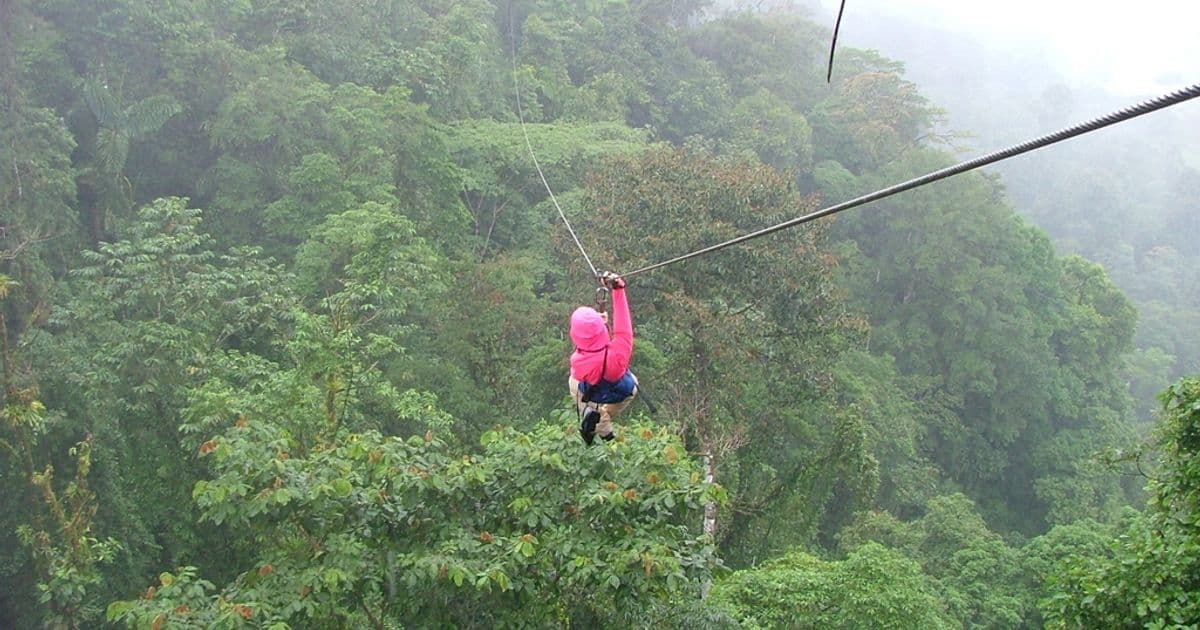
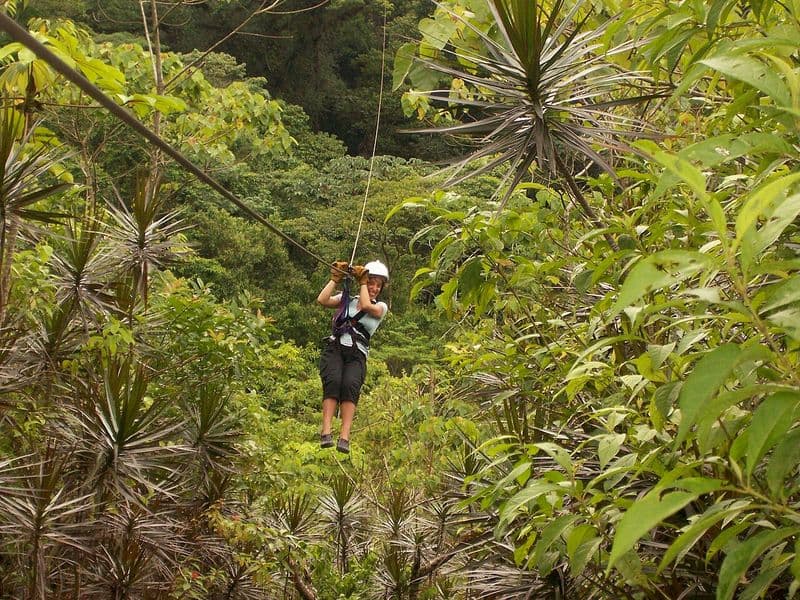
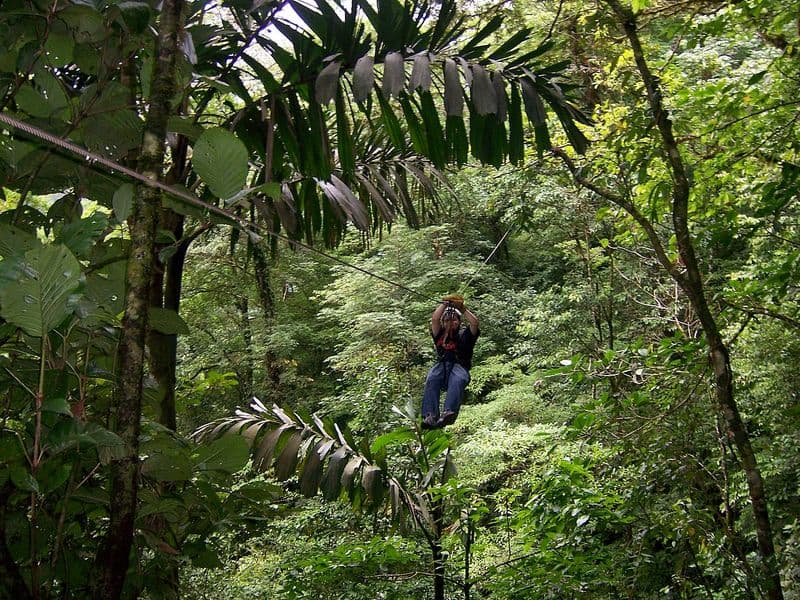
Zip lines (or canopy tours) are one of Costa Rica's most popular adventure activities and allow visitors to fly between platforms high in the forest canopy at high speed. While primarily an adrenaline activity, zip lines pass through forest canopy and tree platforms that occasionally yield wildlife sightings — toucans, monkeys, and sloths are sometimes encountered at platform height. The Arenal area, Monteverde, and Manuel Antonio all have established zip line operations. The Original Canopy Tour at Santa Elena near Monteverde was one of the first commercial zip line operations in the world when it opened in 1997 and helped establish Costa Rica's reputation for adventure tourism.
Aerial Trams Through the Canopy
The Rainforest Adventures aerial tram system, with installations adjacent to Braulio Carrillo National Park on the Caribbean slope and in Guanacaste, offers gondola rides through the forest canopy at a slow, quiet pace suitable for observation and photography. The cable car system carries passengers through the distinct forest layers — ground, understory, mid-canopy, and emergent — allowing a visual appreciation of forest structure impossible on foot. A naturalist guide accompanies each gondola and points out wildlife and ecological features. The Caribbean slope installation near San José is particularly convenient for visitors on day trips from the capital.
Conservation Challenges and Success Stories
Costa Rica's relationship with its forests has undergone a dramatic transformation over the past 50 years. By the 1980s, intensive cattle ranching, banana plantation expansion, and logging had reduced forest cover to less than 20% of the country's land area — one of the highest deforestation rates in Latin America. The situation appeared catastrophic: ancient forests that had evolved over tens of millions of years were being reduced to cattle pasture at a pace that seemed unstoppable.
Costa Rica's reversal of this trend is one of the most celebrated conservation success stories in the world. Through a combination of political will, payments for ecosystem services programs, protected area expansion, and a thriving ecotourism economy that gave forests economic value while standing, forest cover in Costa Rica has recovered to over 52% of the national territory as of recent assessments. The Pagos por Servicios Ambientales (PSA) program, launched in 1997, pays private landowners to maintain and restore forest on their land, channeling funding from water use fees and a fossil fuel tax into forest conservation on private property outside the national park boundaries.
Remaining challenges are significant. Forest fragmentation means that many wildlife populations are isolated in forest islands surrounded by agriculture, limiting genetic exchange and increasing extinction risk. Jaguar populations, estimated at fewer than 60 individuals in Costa Rica, require large connected forest landscapes that no single park can provide alone. The Jaguar Corridor Initiative and the Mesoamerican Biological Corridor project work to connect forest fragments between national parks with reforested buffer zones. Climate change poses increasing threats, altering rainfall patterns, pushing cloud forest zones higher in elevation, and intensifying droughts in the dry forest regions of Guanacaste.
Ecotourism as Conservation
Costa Rica's ecotourism industry directly funds conservation through park entry fees, through the employment of local guides and lodge workers who depend on intact forests for their livelihoods, and through the political constituency for conservation that a tourism-dependent economy creates. Studies have consistently shown that communities adjacent to national parks with strong ecotourism economies have lower deforestation rates and higher support for park expansion than communities without tourism income. Costa Rica's success in connecting nature-based tourism to conservation outcomes has become a model studied and emulated by governments across the tropics.
Planning Your Rainforest Adventure
The best rainforest experiences in Costa Rica are built around early mornings, local guides, and a willingness to move slowly and quietly. Wildlife is most active in the first two hours after dawn and in the hour before sunset. Midday in the lowland rainforest is hot, humid, and generally quiet for wildlife — a good time to return to an air-conditioned lodge, swim, or take a short rest before afternoon activity. Building an itinerary that prioritizes early morning guided walks and evening night tours maximizes wildlife encounters dramatically.
Choosing the right footwear for rainforest hiking is important. The forest floor is frequently muddy, root-covered, and slippery, particularly in the rainy season. Sturdy waterproof hiking boots with ankle support are the best choice for serious hiking in Corcovado or La Selva. Rubber boots, which many lodges provide, are the local choice for very wet conditions. Trail runners or waterproof trail shoes work for less demanding paths. Flip flops, sandals, and sneakers are inappropriate for proper rainforest hiking and increase the risk of ankle injury and insect and snake encounters.
Packing for the rainforest should include lightweight, quick-drying clothing in earth tones or greens (bright colors can startle wildlife), long sleeves and pants for insect and sun protection, a quality insect repellent with DEET or picaridin, a rain jacket or poncho, a wide-brimmed hat, sunscreen for open areas, binoculars, a camera, and at least 2 liters of water per person per half day. A dry bag or waterproof case for electronics is essential during the rainy season. Leave jewelry and unnecessary valuables at the hotel. Tipping guides is customary and greatly appreciated — $10 to $20 USD per person per half day is a reasonable and generous guideline.
Choosing a Rainforest Lodge
The quality of a rainforest lodge experience depends as much on the surrounding forest as on the facilities. Lodges within or immediately adjacent to primary forest or well-managed secondary forest offer dramatically better wildlife watching than lodges in cleared areas near forest edges. Key questions to ask when booking: How much primary forest is on or adjacent to the property? Are certified naturalist guides employed on-site? What trail network is available, and how long are the trails? Are night walks offered? Lodge directories like the Certification for Sustainable Tourism (CST) program can help identify lodges with genuine commitments to environmental management and local community benefit.
Frequently Asked Questions
What is the difference between rainforest and jungle in Costa Rica?
The terms are often used interchangeably in tourism contexts, but technically they differ. Rainforest refers to a closed-canopy tropical forest receiving high annual rainfall, with limited light reaching the ground and a relatively open understory beneath the canopy. Jungle typically refers to secondary or edge vegetation that is denser, tangier, and harder to move through — often the result of disturbance and regrowth where light reaches the ground. Most of what visitors experience at lodges and on guided walks is primary or recovering secondary rainforest.
Is it safe to hike in the Costa Rica rainforest?
Hiking in Costa Rica's rainforest is safe when done with appropriate preparation and, ideally, a knowledgeable guide. The main hazards are venomous snakes (particularly fer-de-lance) — avoided by staying on trails and watching where you step — and biting insects. Getting lost in remote forest is a real risk without a guide. Trails in well-managed parks are generally well-marked. Hydration, sun protection, and appropriate footwear are important safety considerations. Hiking alone in remote forest is not recommended.
What is the best time of year to visit the Costa Rica rainforest?
The dry season (December through April) offers easier hiking conditions, more predictable weather, and better visibility in terms of dense vegetation. However, the rainy season (May through November) has its own advantages: frogs, insects, and many wildlife species are more active; the forest is at its most lush and green; and visitor numbers are significantly lower, meaning more wildlife encounters and more personalized guide attention. Most wildlife biologists would argue the rainy season is actually superior for wildlife watching.
Which Costa Rica rainforest is best for seeing animals?
Corcovado National Park on the Osa Peninsula offers the highest probability of seeing large mammals including tapirs, peccaries, and multiple primate species in an intact rainforest setting. For accessibility combined with excellent wildlife watching, La Selva Biological Station in Sarapiquí is exceptional. For first-time visitors who want a reliable wildlife encounter close to beach tourism infrastructure, Manuel Antonio and Tortuguero are the most practical choices.
Do I need to hire a guide for rainforest hiking in Costa Rica?
A guide is legally required for entering Corcovado National Park. At other destinations, guides are optional but strongly recommended. An experienced naturalist guide can spot wildlife that the vast majority of independent hikers walk past entirely — a motionless green viper on a branch at head height, a sloth 25 meters up in a cecropia, or a glass frog the size of a thumbnail on a leaf. Guides also provide ecological and behavioral context that transforms a walk into a genuine learning experience. The cost of a half-day guide is typically $30–$60 USD and represents exceptional value.