
Costa Rica Snakes: Species Guide, Venomous Risks, and Safety Tips
Costa Rica is home to more than 140 species of snakes, making it one of the most serpent-diverse countries in the Americas relative to its size. From the brilliantly colored eyelash palm pit viper draped over a heliconia flower to the enormous and rarely seen bushmaster lurking in primary forest, Costa Rican snakes represent a fascinating component of the country's extraordinary biodiversity. While the majority of species are harmless and ecologically vital, a handful of highly venomous species require respect and caution from hikers and travelers exploring the country's natural areas.
Overview of Costa Rica's Snake Diversity
Costa Rica's 140-plus snake species occupy every habitat in the country — from sea level mangroves and sandy beaches to cloud forests above 3,000 meters. Of the total species count, approximately 22 are considered venomous to humans, and of those, roughly 17 are members of the pit viper family (Viperidae) while the remainder are rear-fanged colubrids or members of the coral snake family (Elapidae). The vast majority of Costa Rica's snakes are harmless to humans, playing vital ecological roles as predators of rodents, frogs, lizards, and other snakes.
Snake diversity in Costa Rica peaks in the lowland rainforests on both coasts, where warm temperatures, high humidity, and abundant prey support the largest communities of species. The Caribbean lowlands around Tortuguero, Sarapiquí, and the Talamanca foothills harbor particularly high snake diversity. The Osa Peninsula's Corcovado National Park is another hotspot. Cloud forest and highland habitats support fewer species but include several range-restricted endemics, including the highland pit vipers found only in the Talamanca Mountains.
Understanding a few basic facts about snake behavior greatly reduces any risk during a forest visit. Costa Rican snakes are overwhelmingly defensive rather than aggressive — they will strike only when directly threatened, handled, or accidentally stepped on or touched. The vast majority of snakebites in Costa Rica occur when people accidentally step on or near a snake on a trail or in agricultural areas. Maintaining awareness of where you step and place your hands, wearing appropriate footwear, and hiking with a guide dramatically reduces this risk to near zero for the average tourist.
Snake Conservation in Costa Rica
Many of Costa Rica's snake species face population pressures from habitat loss, road mortality, and direct killing by humans who encounter them near farms and homes. Snakes are ecologically critical — they control rodent populations that would otherwise damage crops and spread disease. Conservation education programs in rural communities work to change perceptions of snakes from threats to valuable ecosystem components. The Instituto Clodomiro Picado at the University of Costa Rica has been producing snake antivenom since 1970 and is one of the world's leading centers for snakebite research and treatment, exporting antivenom to countries throughout Latin America and Africa.
Venomous Snakes: The Most Dangerous Species
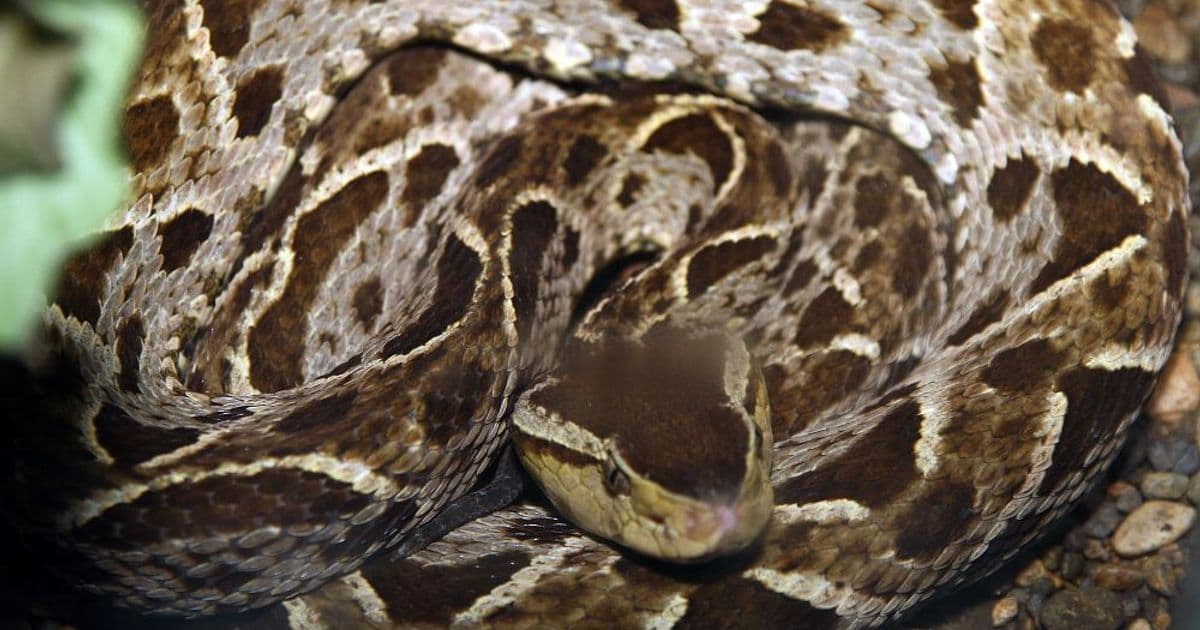
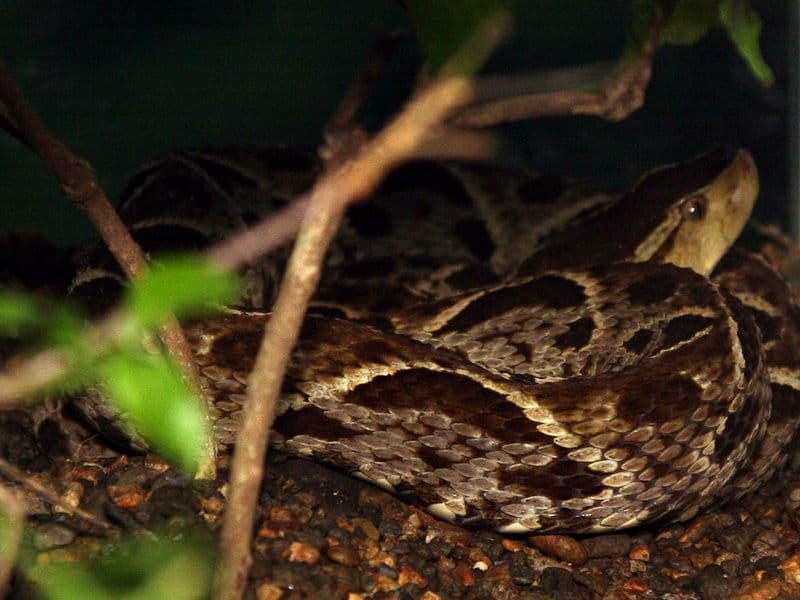
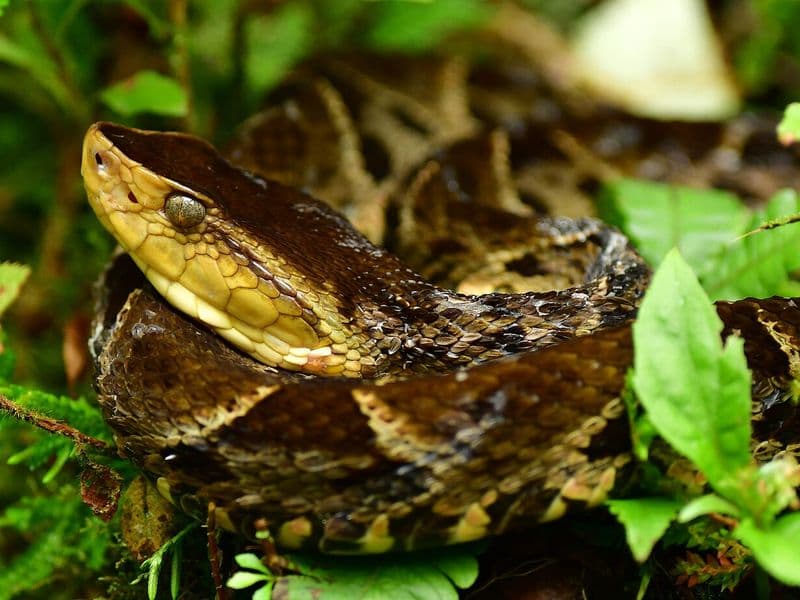
The fer-de-lance (Bothrops asper), known in Costa Rica as the terciopelo — meaning velvet — is the most medically significant venomous snake in the country and is responsible for the majority of serious snakebite cases. A large pit viper reaching lengths of up to 2.5 meters, the fer-de-lance inhabits lowland and middle-elevation forests, agricultural areas, and river edges throughout the country. Its cryptic pattern of geometric brown, tan, and black markings renders it nearly invisible on the forest floor or in dead leaf litter, which is precisely where most accidental encounters occur. Terciopelo venom is strongly hemotoxic, causing tissue destruction, internal bleeding, and in untreated cases, death.
The bushmaster (Lachesis stenophrys) is the longest venomous snake in the Americas, reaching documented lengths of 3 meters or more. Found primarily in undisturbed primary rainforest on the Caribbean slope and Osa Peninsula, the bushmaster is rare and extremely secretive — encounters with tourists are exceptional. Its size and venom yield make it potentially the most dangerous snake in Costa Rica, but its remote habitat and reluctance to bite without significant provocation mean that actual bites are rare. The bushmaster is one of the few snakes that actively guards its eggs, a behavior unusual among pit vipers.
Eyelash palm pit vipers (Bothriechis schlegelii) are among the most photographed venomous snakes in Costa Rica for good reason — they are strikingly beautiful, relatively small, and often found in accessible habitats. Their common name refers to the raised scales above the eyes that give them an almost decorative appearance. They occur in a remarkable range of color morphs including yellow, green, pink, brown, and mottled patterns. They are arboreal, coiling on low vegetation, banana plants, and heliconias at heights comfortable for human encounters. Though not usually fatal when treatment is received promptly, their bites cause significant local tissue damage.
Coral Snakes of Costa Rica
Costa Rica has four species of coral snake (Micrurus), all with the distinctive red, yellow, and black banding that warns predators of their potent neurotoxic venom. The Central American coral snake (Micrurus nigrocinctus) is the most commonly encountered. Coral snakes have small mouths and must chew to inject venom, making bites on humans uncommon and usually occurring only when snakes are handled. The traditional rhyme 'red on yellow kills a fellow, red on black friend of Jack' is not reliable outside North America — in Costa Rica, other non-venomous mimics share similar banding patterns, so treating any banded red-yellow-black snake as potentially venomous is the safest approach.
Side-Striped and Hog-Nosed Pit Vipers
The side-striped palm pit viper (Bothriechis lateralis) and the Godman's pit viper (Cerrophidion godmani) are venomous highland species found in cloud forest and premontane habitats. Both are smaller than the fer-de-lance and less frequently encountered by tourists, but should be treated with the same respect. The hog-nosed pit viper (Porthidium nasutum) is a small terrestrial viper common on the Caribbean lowland forest floor, identifiable by its upturned snout. Though its venom is less potent than the fer-de-lance, it is cryptic and easily stepped upon, making it responsible for bites in agricultural workers and hikers in lowland forest areas.
Non-Venomous Snakes Worth Knowing
The large majority of snakes encountered in Costa Rica are completely harmless to humans. Among the most impressive is the boa constrictor (Boa imperator), which in Costa Rica can reach lengths of 3 meters or more. Boas are powerful constrictors that feed on a wide range of prey including birds, bats, opossums, and small mammals. They are found throughout lowland habitats on both coasts and are frequently seen basking on tree branches in secondary forest near the coast and along river edges. Despite their impressive size, boas are non-venomous and non-aggressive, though they will bite defensively if handled.
The indigo snake (Drymarchon melanurus) is one of the largest non-venomous snakes in the Americas, reaching over 2 meters in length. It is a diurnal forager that actively hunts other snakes — including venomous species — making it one of the most ecologically beneficial large snakes in Costa Rica. Its glossy black body and quick, alert movement distinguish it from the slower pit vipers. The Central American rat snake (Pseudelaphe flavirufa) and the various species of racer snakes (Dryadophis, Dendrophidion) are slender, fast-moving inhabitants of forest edges and secondary vegetation that feed primarily on lizards and frogs.
The mussurana (Clelia clelia) deserves special mention as a species specifically adapted to prey on venomous snakes. This large, dark-bodied snake is immune to the venom of pit vipers and regularly preys on fer-de-lances and other dangerous species. Partly for this reason, the mussurana is considered highly beneficial and is given protection status in some contexts in Costa Rica. Vine snakes of the genus Oxybelis are slender, extremely elongated arboreal snakes that rely on their pencil-thin shape and slow, swaying movement to mimic vegetation. They are mildly rear-fanged but harmless to humans and are among the most elegant-looking reptiles in the country.
Green Tree Snakes and Parrot Snakes
Several species of bright green tree snakes are common in Costa Rica and are sometimes mistaken for venomous species by visitors unfamiliar with local fauna. The parrot snake (Leptophis ahaetulla) is a vivid green arboreal species with an iridescent sheen, found throughout lowland and middle-elevation forests. It is completely harmless and often seen in gardens, forest edges, and secondary vegetation hunting lizards and frogs in the shrub layer. The rough green snake (Opheodrys aestivus) is another harmless green species adapted to lush vegetation in humid environments. A qualified guide can easily distinguish these species from venomous ones.
Snake Safety Tips for Hikers and Travelers
The most effective snake safety measure for Costa Rica visitors is appropriate footwear. Wearing sturdy ankle-covering hiking boots rather than sandals or flip flops when hiking in forest environments dramatically reduces the risk of a bite to the foot or ankle — the most common bite location for people who accidentally step near a snake. Rubber boots, commonly available for rent at jungle lodges, cover the lower leg and provide excellent protection against ground-dwelling species like the fer-de-lance. Many jungle lodge staff wear rubber boots as standard footwear in the field for precisely this reason.
Always watch where you step on forest trails, particularly when stepping over logs, roots, or through dense leaf litter where snakes are difficult to see. Never put your hand into crevices, holes, or dense vegetation without looking first. This includes reaching behind waterfalls, into rock faces, or under driftwood at the beach. When stepping over a log or obstacle, step on top of it first to check the other side before placing your foot beyond it — many bites occur when a person's foot lands next to a snake on the far side of an obstacle they stepped over without looking.
Carry a headlamp or flashlight on night walks and always check the ground in front of you before placing each step. Snakes are more active at night in the lowland tropics and can be encountered on lodge pathways, in bathrooms, and on porches in addition to forest trails. Using a stick to gently probe vegetation before reaching into it is a simple precaution. Never attempt to handle, capture, or move any snake encountered in the wild — this is when the majority of serious bites occur, even to experienced herpetologists.
Snake Avoidance in Agricultural Areas
Farmworkers in Costa Rica's agricultural regions, particularly banana plantation workers and cattle ranchers, account for the majority of snakebite cases reported each year. Visitors staying at rural lodges or walking through agricultural areas should be particularly vigilant in areas with cut grass, compost piles, fruit storage areas, and irrigation ditches — all locations that attract rodents and, consequently, the snakes that hunt them. The fer-de-lance is exceptionally common in banana plantations, where rodents drawn to the fruit and irrigation water create an ideal hunting environment.
What to Do If You Encounter a Snake
If you encounter a snake on a trail or in your surroundings, the appropriate response is to stop moving immediately, identify the snake's location, and back away slowly without sudden movements. Give the snake time to move away on its own — most snakes, even venomous ones, will retreat if given the opportunity. Never attempt to prod, pin, or pick up any snake, even a species you believe to be harmless. Identification of snake species in the field is challenging even for experts, and a misidentification can have serious consequences.
In the event of a snakebite, the most important immediate action is to get the victim to a hospital or medical facility as quickly as possible. Do not attempt to suck out the venom — this is ineffective and can introduce bacteria. Do not apply a tourniquet, ice, or cut the bite area — these measures increase tissue damage and complicate medical treatment. Keep the bitten extremity at or below heart level and minimize physical activity to slow the spread of venom through the lymphatic system. Remove rings, watches, and tight clothing from the affected limb before swelling begins. Note the time of the bite and, if safely possible without approaching the snake again, photograph or describe the snake's appearance for the treating physician.
Antivenom for the most medically significant Costa Rican pit vipers, including the fer-de-lance and bushmaster, is produced by the Instituto Clodomiro Picado at the University of Costa Rica and is widely available at Costa Rican hospitals and many rural health clinics. Prompt administration of appropriate antivenom is the single most important factor in snakebite treatment outcomes. Major hospitals in San José, Liberia, San Carlos, and other regional centers all carry antivenom and have staff experienced in snakebite management. The Costa Rican emergency number is 911.
Snakebite Statistics in Costa Rica
Costa Rica records approximately 500 to 700 snakebites per year, of which a very small number are fatal — typically fewer than five annually, and usually in cases where treatment was significantly delayed. The vast majority of bites occur in agricultural workers rather than tourists. The country's well-developed antivenom production and distribution system, combined with a national health system that covers snakebite treatment, has driven the fatality rate from snakebite down dramatically over the past 50 years. Tourists visiting Costa Rica's national parks and lodges face an extremely low risk of snakebite when basic precautions are followed.
Where to See Snakes in Costa Rica
For visitors who specifically wish to observe snakes in controlled or semi-controlled settings, several wildlife exhibits and reptile parks throughout Costa Rica maintain living snake displays. The Serpentario (serpentarium) in San José's Old Town is one of the oldest reptile exhibits in Central America and displays a wide variety of native snake species in enclosures with interpretive signage. The World of Snakes (El Mundo de las Serpientes) near Grecia in Alajuela province is a private research and education center housing one of the largest collections of Costa Rican snake species and is open for guided visits. These facilities allow close-up, completely safe observation of species that might never be encountered in the wild.
In the wild, night walks are the most productive way to observe snakes. The eyelash palm pit viper, being arboreal and nocturnal, is regularly encountered on guided night walks in the Caribbean lowlands around Tortuguero and Puerto Viejo de Sarapiquí. Ground-dwelling species like the fer-de-lance can be spotted on night walks in lowland forest when guides use careful illumination techniques to reveal their cryptic resting positions. La Selva Biological Station in Sarapiquí, where researchers have conducted herpetological inventories for decades, has some of the highest snake encounter rates of any guided walk destination in Costa Rica.
Daytime encounters with non-venomous species are relatively common for attentive walkers. Boa constrictors are frequently spotted basking in branches near rivers and forest edges. Green vine snakes and parrot snakes are sometimes seen moving through vegetation in gardens and forest borders near lodges. Imantodes thread snakes — very slender, large-eyed arboreal species — are commonly encountered on vegetation at night near light sources that attract the frogs they hunt. Any snake encounter in the wild should be observed from a safe distance and never interfered with.
Herpetology Research in Costa Rica
Costa Rica has been a center for tropical herpetology research for over a century, with significant contributions from researchers at La Selva, Las Cruces, and the Universidad de Costa Rica. The country's snake fauna has been inventoried more thoroughly than that of most tropical countries, providing a solid scientific foundation for conservation and education. Several species have been discovered and formally described in recent decades, and ongoing surveys continue to refine understanding of distribution, ecology, and population status. Visitors with a serious interest in snake biology can often arrange to join herpetological surveys with La Selva or INBIO researchers through advance contact with these institutions.
Frequently Asked Questions
Are there a lot of snakes in Costa Rica?
Costa Rica has over 140 snake species, which is a high diversity for its geographic area. However, most species are secretive and encounters during normal tourist activities are uncommon. Snakes are not 'crawling everywhere' as some visitors fear. Basic precautions — appropriate footwear, staying on marked trails, watching where you step — reduce any meaningful risk to near zero. Many visitors spend weeks in Costa Rica without seeing a single snake.
What is the most dangerous snake in Costa Rica?
The fer-de-lance (terciopelo) is considered the most medically important venomous snake in Costa Rica because of its abundance, wide distribution, and powerful hemotoxic venom. The bushmaster is potentially more dangerous per bite due to its larger size and venom yield, but bites are extremely rare due to its remote habitat and secretive nature. Eyelash palm pit vipers are frequently encountered in accessible areas but are smaller and cause fewer fatalities.
Can tourists safely visit Costa Rica without worrying about snakes?
Yes. Tourists who wear appropriate footwear, stay on marked trails, avoid putting hands into unseen spaces, and follow the guidance of knowledgeable guides face an extremely low risk of snakebite. The vast majority of snakebite victims in Costa Rica are farmworkers who encounter snakes during agricultural activities, not tourists visiting parks and lodges. Reasonable awareness and basic precautions make the risk to tourists negligible.
How do I tell if a snake in Costa Rica is venomous?
Reliably identifying venomous from non-venomous snakes in the field requires significant expertise. Some generalizations help: triangular head (suggests pit viper), heat-sensing pits between eye and nostril (pit viper), red-yellow-black banding (possible coral snake). However, these features can be misleading, and many harmless species mimic venomous ones. The safest approach is to treat every snake as potentially venomous, observe from a distance, and never attempt to handle or provoke any snake encountered in the wild.
Where in Costa Rica can I safely see live snakes?
The Serpentario in San José and El Mundo de las Serpientes near Grecia both maintain extensive collections of living native snake species in safe, interpretive settings open to visitors. Night walks with certified guides in the Caribbean lowlands — particularly around Tortuguero, La Selva, and Puerto Viejo — frequently produce encounters with eyelash palm pit vipers and various harmless species in their natural habitat. Guided night walks from jungle lodges commonly include snake encounters as part of the experience.