
Manuel Antonio, Costa Rica: Wildlife, Beaches, and National Park Guide
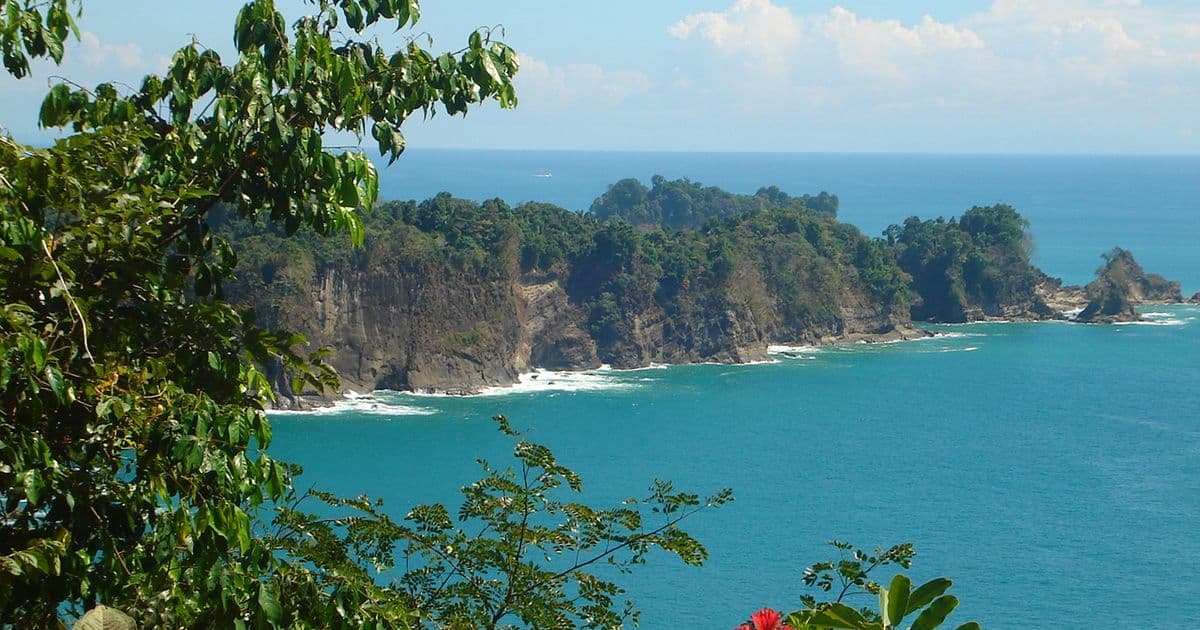
Manuel Antonio is one of Costa Rica's most beloved destinations, combining a world-famous national park with stunning Pacific beaches and a vibrant town filled with restaurants and eco-lodges. Located 180 kilometers south of San José on the Central Pacific coast, Manuel Antonio National Park is the country's smallest national park yet one of its most biodiverse and visited, drawing nearly 200,000 visitors per year. The area offers an exceptional combination of wildlife watching, swimming, hiking, and upscale eco-tourism.
Manuel Antonio National Park
Manuel Antonio National Park was established in 1972 and covers 1,983 hectares of primary and secondary rainforest, mangrove estuaries, and protected marine zones. Despite being the smallest of Costa Rica's national parks, it protects an impressive range of ecosystems and species within its compact boundaries. The park entrance is located at the end of a road from the town of Quepos, about 7 kilometers away.
The park has a daily visitor capacity limit of 800 people, implemented to reduce environmental impact. Reservations must be made in advance through the SINAC (National System of Conservation Areas) website, and the park is closed on Tuesdays. Entrance fees are approximately $18 per person for foreign adults. Arriving early — at opening time of 7:00 AM — is highly recommended to see wildlife before the heat of the day and before crowds increase.
The park's trail system is well-maintained and ranges from easy flat walks to moderately steep hillside trails. The main trail network covers roughly 16 kilometers total. Naturalist guides can be hired at the park entrance and dramatically improve wildlife spotting — their trained eyes and spotting scopes help visitors see well-camouflaged sloths, caimans, and birds that most independent visitors walk right past.
Park Hours and Reservations
Manuel Antonio National Park is open Wednesday through Monday from 7:00 AM to 4:00 PM (last entry at 2:00 PM), closed on Tuesdays. Online reservations through the SINAC website are mandatory during peak season (December–April) and strongly recommended year-round. The park sells out its daily capacity quickly, especially on weekends and holidays.
Wildlife of Manuel Antonio
Manuel Antonio is justly famous for its accessible and abundant wildlife. The park's four species of monkeys — white-faced capuchin, mantled howler, Central American squirrel monkey, and Geoffroy's spider monkey — are the star attractions. Squirrel monkeys are particularly notable as an endangered species found in only a few locations on the Pacific coast. Troops of capuchins and squirrel monkeys are commonly seen along park trails, sometimes close enough to touch (though feeding or touching wildlife is strictly prohibited).
Sloths — both two-toed and three-toed species — are commonly spotted in the park's trees, particularly around the beach areas. Their slow movements make them difficult to spot without guidance, but once located they are easy to observe at length. Other commonly seen mammals include agoutis, white-nosed coatis, and raccoons along the beach areas.
Bird life is exceptional, with over 184 species recorded in the park. Highlights include the scarlet macaw (more easily seen at Carara to the north but occasionally present), fiery-billed aracari, various tanagers, and numerous raptor species. Reptiles including green iguanas, caimans in the lagoon near the park entrance, and various snake species round out the wildlife experience.
Squirrel Monkeys of Manuel Antonio
The Central American squirrel monkey (Saimiri oerstedii citrinellus) is an endangered subspecies found only in Manuel Antonio and the Osa Peninsula in Costa Rica. The population declined dramatically in the 20th century due to deforestation and hunting. Conservation efforts including wildlife corridors connecting the park to surrounding forests have helped stabilize the population, which now numbers in the thousands.
Marine Wildlife
The park's marine zone protects offshore rocks and reefs where dolphins, sea turtles, and seasonal humpback whales can be observed. Snorkeling at Playa Biesanz and around offshore rocks reveals colorful reef fish, rays, and invertebrates. Whale watching tours from Quepos encounter humpback whales during both northern and southern hemisphere migration seasons.
Beaches Within and Near the Park
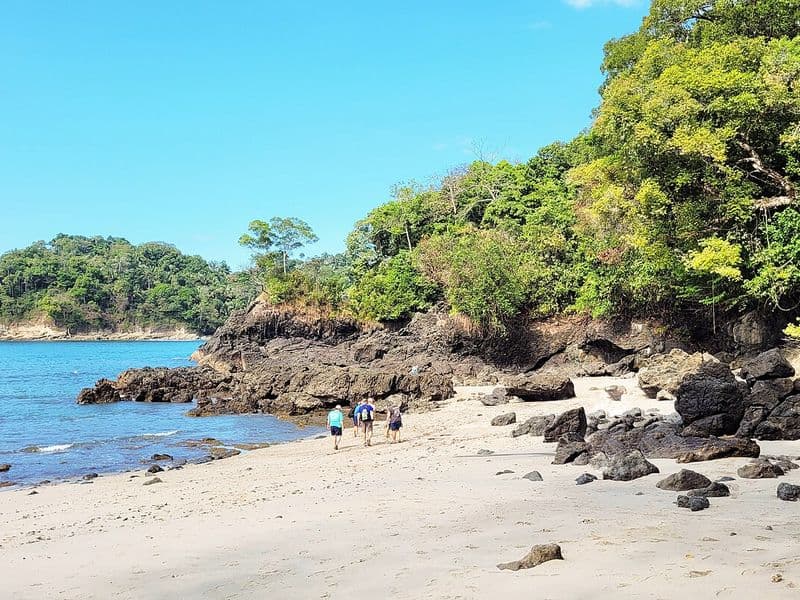
Manuel Antonio National Park contains four beaches within its boundaries, each with distinct character. Playa Espadilla Sur is the longest beach in the park, a curved arc of golden-white sand backed by forest. Its gentle slope and typically calm water make it suitable for swimming, though rip currents can develop — look for posted warning flags. Playa Manuel Antonio is the most protected and popular beach in the park, a small, nearly enclosed bay with calm turquoise water ideal for families and snorkelers.
Playa Biesanz, reached by a short path outside the main park entrance, is a small, quiet cove favored by snorkelers. The protected bay hosts reef fish and occasionally sea turtles. Playa Puerto Escondido, accessible during low tide by crossing a rocky headland, is more remote and sees fewer visitors.
Outside the park, Playa Espadilla Norte runs along the road between Quepos and the park entrance. This beach is public and free to access but exposed to stronger waves than the park beaches. It is a popular spot for surfing and body boarding.
Swimming Safety
Rip currents are present at Manuel Antonio's beaches, particularly on Playa Espadilla Norte outside the park. Always check posted flag warnings (green = safe, yellow = caution, red = dangerous, black = closed). If caught in a rip current, swim parallel to shore rather than fighting the current directly back to the beach. Park staff patrol the beaches during open hours.
The Town of Quepos and Local Services
Quepos is the service town for the Manuel Antonio area, located 7 kilometers from the park entrance. The town has a long history as a banana and African palm plantation hub before tourism became the dominant industry. Today, Quepos offers supermarkets, pharmacies, banks, ATMs, a hospital, post office, and numerous local restaurants and bars catering to both tourists and residents.
The marina at Quepos is one of the main sport fishing departure points on the Central Pacific coast. Sailfish, marlin, dorado, and yellowfin tuna are targeted year-round, with peak marlin season from May through October. The marina also hosts sunset cruises and whale watching tours. White-water rafting on the Río Savegre, one of Costa Rica's cleanest rivers with Class III–IV rapids, departs from Quepos and is a popular full-day excursion.
Getting to Manuel Antonio
Quepos and Manuel Antonio are served by direct buses from San José's Coca-Cola terminal, a journey of approximately 3.5 hours. Shared shuttles from major San José hotels take about 3 hours. The regional airport in Quepos (XQP) receives daily flights from San José on Sansa Airlines, a 30-minute flight. Driving from San José via the Costanera highway takes approximately 3 hours.
Hotels and Accommodation
Manuel Antonio has one of the highest concentrations of boutique eco-lodges and hillside hotels in Costa Rica, many offering spectacular ocean views from private pools and terraces. The road between Quepos and the park entrance is lined with properties ranging from budget guesthouses to world-class luxury resorts.
Arenas del Mar is a leading sustainable luxury property with direct beach access and biodiversity-focused programming. Si Como No Resort is a long-established eco-certified hotel with ocean views, two pools (one with a waterslide for families), and an on-site wildlife refuge. Gaia Hotel & Reserve is a boutique adults-only property emphasizing wellness and exclusivity with panoramic views of the Pacific.
Budget travelers will find hostels and guesthouses in Quepos town, where prices are considerably lower than in the hotel zone along the road to the park. The tradeoff is a 7-kilometer commute to the beach and park entrance, manageable by taxi, bus, or bicycle.
Eco-Certification in the Area
Manuel Antonio has a high concentration of hotels holding Costa Rica's Certification for Sustainable Tourism (CST), a government-run rating system assessing environmental impact, community engagement, and cultural sustainability. Staying at CST-certified properties directly supports the local conservation economy. Look for the blue-and-green leaf logo when booking.
Practical Tips for Visiting
Book park entry in advance through the SINAC website, especially for visits between December and April or on weekends. The park sells out its daily 800-person capacity regularly. Entry tickets must be purchased online — walk-up entries are not guaranteed and may be denied if capacity is reached.
Hiring a naturalist guide at the park entrance significantly improves the experience. Guides charge approximately $20–$30 per person for a 2–3 hour tour. They carry spotting scopes that reveal sloths, monkeys, and birds that most visitors miss entirely. Tours are offered in English and Spanish. Bring insect repellent, sunscreen, water, and a light rain jacket as afternoon showers can occur even in dry season.
Do not feed or approach wildlife under any circumstances. Monkeys and coatis in the park have been known to snatch food and bags from inattentive visitors. Keep food secured in your backpack, be alert around open picnic areas, and never offer food to any animal. Doing so is illegal and harmful to their health and natural behavior.
What to Bring
Essentials for a Manuel Antonio park visit include: reef-safe sunscreen (conventional sunscreen is harmful to marine ecosystems and reef-safe versions are expected), biodegradable insect repellent, plenty of water (a minimum of 2 liters per person for a half-day visit), sturdy sandals or water shoes for beach trails, a dry bag or waterproof phone case, and binoculars or a zoom camera for wildlife photography.
Frequently Asked Questions
Do I need to book Manuel Antonio National Park in advance?
Yes, advance booking is strongly recommended and required during peak season (December–April). The park has a daily capacity of 800 visitors and regularly sells out, especially on weekends and holidays. Book through the official SINAC website as early as possible. The park is closed on Tuesdays.
Is Manuel Antonio good for families with children?
Manuel Antonio is an excellent family destination. Children love spotting monkeys, sloths, and iguanas along the trails. Playa Manuel Antonio inside the park has calm, protected waters safe for young swimmers. The area has many family-friendly hotels, and the short trail distances are manageable for most children over age 5.
Can I see sloths at Manuel Antonio?
Yes, sloths (both two-toed and three-toed species) are commonly seen in the park's trees. They are notoriously difficult to spot on your own due to their slow movements and excellent camouflage. Hiring a naturalist guide significantly increases your chances — guides carry spotting scopes and know exactly where to look.
What is the difference between Manuel Antonio and Quepos?
Quepos is the larger service town with supermarkets, banks, a marina, and the local hospital, located 7 km from the national park entrance. Manuel Antonio refers both to the national park and to the smaller community along the road between Quepos and the park, where most hotels and restaurants are concentrated. Most visitors stay in the hotel zone along this road.
How long should I spend at Manuel Antonio?
Most visitors spend 2–3 nights in Manuel Antonio/Quepos to allow one full day in the national park plus time to relax on the beach, take a day trip (whale watching, rafting, or a tour of a local cacao farm), and explore the restaurant scene. A single full day is the minimum to justify the journey from San José.