
Quetzal Costa Rica: Finding the Resplendent Quetzal in Cloud Forest
The resplendent quetzal is considered by many naturalists and ornithologists to be the most beautiful bird in the Americas, and Costa Rica is one of the most reliable places on Earth to observe it in the wild. With its shimmering emerald-green body, crimson belly, and spectacular tail feathers that can extend a full meter beyond the body of a breeding male, the quetzal has captivated human imagination for thousands of years. Once sacred to the Maya and Aztec civilizations, the quetzal now draws birdwatchers, photographers, and nature lovers from around the world to Costa Rica's misty cloud forests.
About the Resplendent Quetzal
The resplendent quetzal (Pharomachrus mocinno) is a member of the trogon family (Trogonidae) and is widely regarded as one of the most spectacular birds on Earth. The species is found from southern Mexico to western Panama, with Costa Rica's highland forests being among the most accessible and reliable locations for observation. Males and females differ dramatically in appearance — a degree of sexual dimorphism unusual even among birds known for colorful plumage.
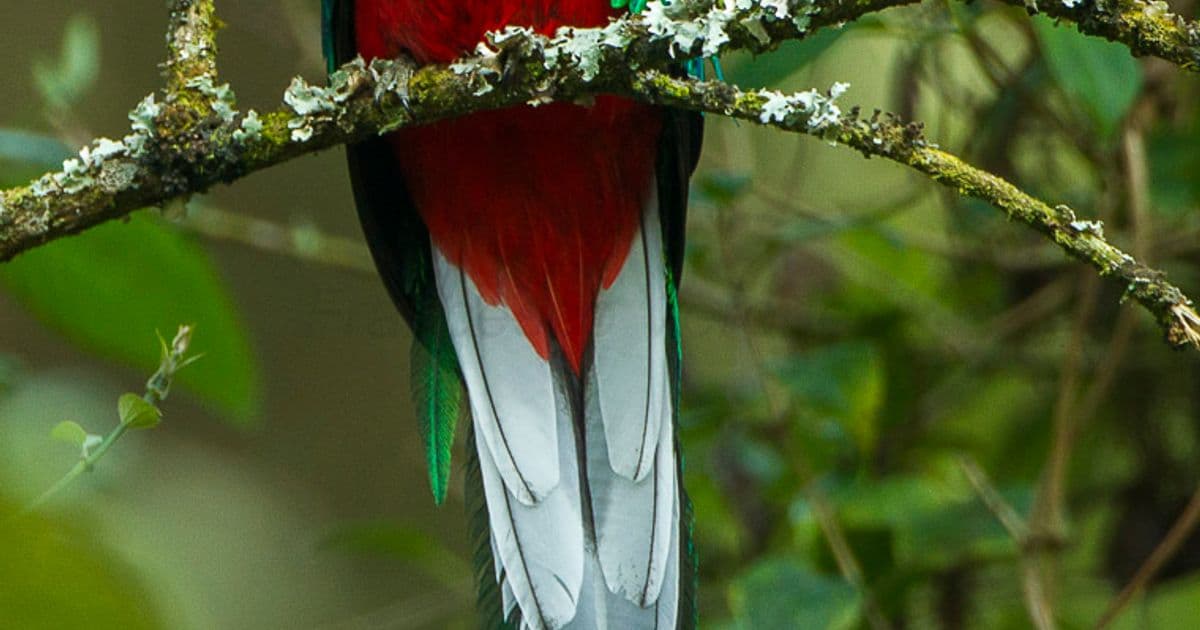
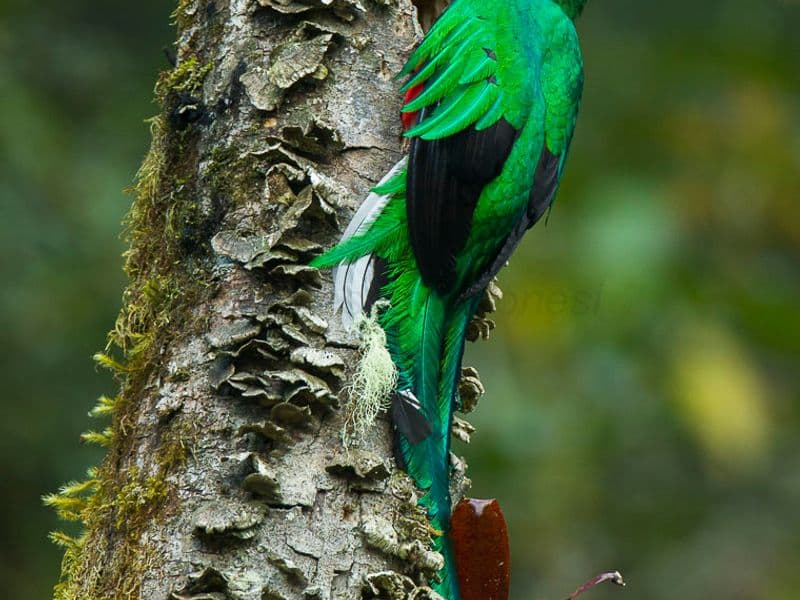
The male resplendent quetzal is the showpiece of the pair. His body plumage is a deep iridescent green that shifts from emerald to blue-green to golden depending on the angle of light, created by the structural properties of the feather barbules rather than pigmentation alone. The belly is brilliant crimson. The head bears a rounded crest of fine, filamentous green feathers. Most spectacularly, the male develops extraordinary upper tail coverts during breeding season — long, banner-like green feathers that extend 60 to 100 centimeters beyond the actual tail. These ornamental feathers, sometimes referred to as quetzal plumes, were among the most precious objects in pre-Columbian Mesoamerican cultures, worn only by royalty and high priests.
The female quetzal, while lacking the tail plumes, is still beautiful in its own right — she shares the green body coloring but has a gray or bronze-tinted head, a barred tail, and a salmon-red belly rather than the male's brilliant crimson. Both sexes share the rounded head profile, large eyes adapted to the dimly lit cloud forest understory, and the trogon family's characteristic habit of sitting motionless for long periods before making short sallying flights to pluck fruit from branches.
The Quetzal in Pre-Columbian Culture
For the Maya and later the Aztec civilizations, the resplendent quetzal was a sacred bird of extraordinary cultural and religious significance. The quetzal's tail plumes were more valuable than gold in Mesoamerican trade and were worn exclusively by rulers and high priests. Quetzalcoatl — the feathered serpent deity of central Mexican civilization — combines the quetzal's plumes with the serpent's body in one of the most powerful religious symbols of pre-Columbian America. In Guatemala, the quetzal remains the national bird and the name of the national currency. The bird's association with freedom — legend holds that the quetzal cannot survive in captivity — gives it additional symbolic power throughout Mesoamerica.
Quetzal Habitat in Costa Rica
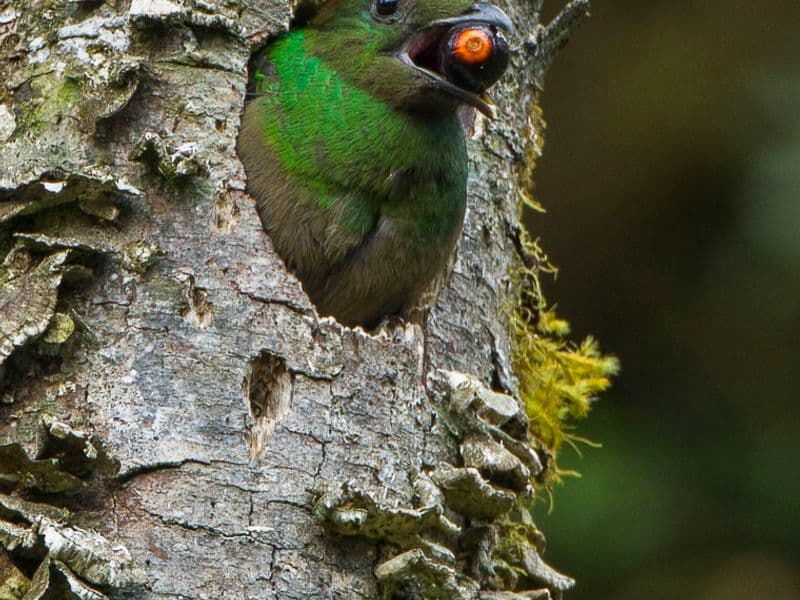
Quetzals in Costa Rica are cloud forest specialists, found between approximately 1,500 and 3,000 meters elevation in the cool, mist-saturated mountain forests of the Tilarán, Central, and Talamanca mountain ranges. They are among the most specialized frugivores in the cloud forest ecosystem, with a diet heavily dominated by wild avocados — small-fruited members of the laurel family (Lauraceae) that produce fruit perfectly sized to be swallowed whole by a quetzal. The relationship between quetzals and laurel trees is mutualistic: quetzals disperse the seeds of many laurel species in their droppings after passing through the digestive system, making quetzals critical seed dispersers for cloud forest tree regeneration.
The vertical distribution of quetzals in Costa Rica is not static throughout the year. During the dry season (December through April), quetzals typically nest and concentrate at higher elevations, particularly in the primary cloud forest zones where their preferred laurel food trees fruit most abundantly during this period. As the year progresses and the fruiting phenology of laurel species shifts altitudinally, quetzals undertake altitudinal migrations — moving downslope to lower elevations during the wet season as fruit availability follows rainfall patterns. This seasonal movement pattern, while not a true migration in the conventional sense, means that quetzal watching hotspots can shift between seasons.
Primary cloud forest is strongly preferred by breeding quetzals, which nest in natural cavities in large, decaying trees. The availability of suitable nesting trees — which requires large-diameter dead trees with pre-existing or excavatable cavities — is a key limiting factor for quetzal breeding density. Secondary cloud forest recovering from selective logging or agricultural abandonment can support quetzals if it contains sufficient fruiting laurel trees, but typically at lower densities than intact primary forest. The protection of large blocks of primary cloud forest with full canopy coverage and a diversity of laurel species is the foundation of quetzal conservation.
Quetzal Food Trees: Wild Avocados
The fruiting phenology of wild avocado trees (Lauraceae) in Costa Rica's cloud forests is closely tied to quetzal behavior and distribution. Several Ocotea and Nectandra species produce small, avocado-like fruits throughout the year at different elevations, creating a seasonal cascade of fruiting that quetzals track altitudinally. In the San Gerardo de Dota valley, local guides have documented which trees are currently fruiting and which individual quetzals are visiting them — local ecological knowledge that dramatically increases the reliability of quetzal observations for visiting birdwatchers. The protection of these specific fruiting trees, even within otherwise modified landscapes, can maintain quetzal presence in areas where primary forest has been reduced.
Best Places to See Quetzals in Costa Rica
The San Gerardo de Dota valley in the Talamanca Mountains, accessible from the Pan-American Highway at kilometer marker 80 south of San José, is widely considered the best quetzal-watching destination in Costa Rica. The valley sits at approximately 2,100 to 2,600 meters within the buffer zone of Chirripó National Park and contains extensive primary cloud forest where quetzals are present year-round and reliably abundant during breeding season from January through May. Several small family-run lodges in the valley — most notably Savegre Hotel Natural Reserve and Spa — offer guided quetzal walks led by local guides with decades of experience tracking individual birds.
Monteverde Cloud Forest Reserve and the adjacent Santa Elena Reserve on the Tilarán Mountain Range are the most famous cloud forest destinations in Costa Rica and reliable quetzal locations, particularly during the nesting season. The Monteverde area receives more visitors than any other cloud forest in the country, and the quetzal viewings here are more variable than in the San Gerardo de Dota valley due to visitor density and less predictable individual bird locations. However, experienced resident guides at Monteverde maintain detailed knowledge of current quetzal nesting sites and feeding trees, and dedicated morning birding walks with a specialist guide yield excellent results.
Cerro de la Muerte (Peak of Death), the highest point on the Pan-American Highway at approximately 3,491 meters, offers roadside quetzal watching in páramo and upper cloud forest habitat. Quetzals are present at these very high elevations during certain seasons, and the highway pullouts between kilometer markers 70 and 80 are well-known birding sites where organized birding groups stop regularly. The Providencia and Genesis II Cloud Forest Reserve area nearby, accessible via rough road from the highway, protects excellent primary cloud forest with reliable quetzal presence.
San Gerardo de Dota: The Top Quetzal Destination
San Gerardo de Dota valley has emerged as the definitive quetzal destination in Costa Rica over the past two decades. The valley's relatively low tourism density compared to Monteverde, combined with excellent primary forest, experienced local guides from multigenerational farming families, and the concentration of quetzals during breeding season, creates optimal conditions for extended and unrushed observation. Visits of two to three nights allow multiple morning walks in different forest sections, dramatically increasing the probability of observing both male and female quetzals, and potentially witnessing territorial displays, nest examination, and the full repertoire of quetzal behavior.
Braulio Carrillo National Park Quetzals
The higher elevations of Braulio Carrillo National Park on the continental divide between San José and the Caribbean coast support quetzals in less visited and more challenging terrain than either Monteverde or Dota. The Zurquí ranger station section of the park, accessible from the main highway near the Braulio Carrillo tunnel, reaches cloud forest elevations suitable for quetzals. Quetzal sightings here are less reliable than at the specialist destinations, but the park's biodiversity — including many other cloud forest specialties — rewards the effort for dedicated birders combining multiple species targets.
Quetzal Watching: Seasons and Behavior
The resplendent quetzal's annual behavioral cycle creates distinct seasons for quetzal watching, each with different rewards and challenges. The breeding season, from approximately January through May (peaking February through April), is when male quetzals develop their full tail plumes, become highly territorial, and engage in spectacular aerial display flights above the cloud forest canopy. During this period, males are conspicuous and active, calling frequently, chasing rival males, and visiting nesting sites — all behaviors that make them significantly easier to locate and observe than during non-breeding periods. This is the time when the quetzal reaches the full magnificence of its plumage and is at its most photogenic.
Both male and female quetzals participate in incubation, with each sex taking turns at the nest during daylight hours. The nest is typically excavated in a decaying tree trunk or stump at a height of 5 to 30 meters. The extraordinary tail plumes of the male create a practical challenge at the nest: the plumes must drape outside the cavity entrance while the male sits inside incubating, creating the remarkable sight of long green streamers extending from what appears to be a hole in a tree trunk. Local guides in San Gerardo de Dota are skilled at locating active nests and positioning visitors for this extraordinary observation.
After the breeding season concludes in May or June, adult quetzals begin their altitudinal movement to lower elevations following the seasonal fruiting of lower-elevation laurel species. During this period from June through December, quetzals are less conspicuous — males have shed their ornamental plumes and individuals are less territorial — but they remain present in the cloud forest and can be found with sufficient effort and local knowledge. Visiting birders during the wet season may find quetzals in slightly lower elevations and in a wider range of cloud forest habitats as they track fruit availability.
Quetzal Vocalizations
The quetzal's vocalizations are distinctive and once learned, serve as the primary method for locating birds in thick cloud forest vegetation where visual detection is challenging. The male's advertising call is a series of deep, melodious two-note phrases — sometimes rendered as 'kyow' or 'ke-wow' — repeated at regular intervals from high in the canopy. During territorial interactions, more complex and rapid calling sequences occur. Female calls are similar but softer. Experienced guides in quetzal country begin the morning walk by listening for calls before heading into the forest, using the bird's own vocal advertising to pinpoint its location before searching visually.
Photography Tips for Quetzals
Photographing quetzals in Costa Rica's cloud forest presents specific technical challenges. The forest is typically dimly lit due to cloud cover, the birds can be at significant heights in the canopy, and the iridescent plumage requires particular lighting conditions to capture its full brilliance. A telephoto lens of at least 400mm focal length (full-frame equivalent) is generally necessary for frame-filling images of a quetzal in a tree. Shorter focal lengths are workable when birds descend to lower perches, but this is unpredictable. Image stabilization and a fast maximum aperture (f/4 or f/5.6) assist in the low-light conditions of cloud forest mornings.
The ideal photographic situation for quetzals is when a bird feeds at a known fruiting tree at a relatively low height — 10 to 20 meters — in a location where open sky rather than dark forest forms the background. San Gerardo de Dota guides are particularly skilled at positioning photography clients at productive feeding trees in good light. Morning sessions between 6 and 9 a.m., when quetzals are most active and feeding before cloud cover thickens, provide the best natural light. Dappled forest light can create challenging exposure conditions — using exposure compensation and spot metering from the bird's plumage rather than the sky produces consistently better results.
Quetzals feeding in fruiting trees often hover momentarily to pluck fruit before returning to a perch — a behavior that creates opportunities for in-flight photography at close range. Setting continuous autofocus tracking mode before the bird begins feeding allows rapid capture of the hover-and-pluck sequence. The male's tail plumes during flight create spectacular trailing green streamers that, when captured in a sharp image, represent one of the most prized wildlife photographs possible in Central America. Patience and repeated positioning visits over multiple mornings dramatically increase the probability of capturing this defining shot.
Ethical Wildlife Photography at Quetzal Sites
Quetzal photography should always prioritize the bird's welfare over image capture. Never use playback of recorded quetzal calls to attract birds — this disrupts territorial behavior, stresses breeding birds, can cause nest abandonment, and is prohibited in many cloud forest reserves. Maintain a minimum observation distance and do not approach a nest cavity, as this can cause female desertion of eggs or chicks. Avoid repeatedly flushing birds from a perch by approaching too closely. The goal of ethical wildlife photography is to minimize impact on natural behavior while capturing authentic documentation of the animal in its habitat.
Conservation Status and Threats
The resplendent quetzal is classified as Near Threatened on the IUCN Red List, reflecting ongoing population declines driven primarily by cloud forest habitat loss. While the quetzal has a relatively extensive range from Mexico to Panama, large portions of that range have experienced severe cloud forest deforestation, fragmenting quetzal populations into isolated subpopulations that lose genetic diversity over time. In Costa Rica, where cloud forest protection has been relatively strong compared to some other countries in the quetzal's range, the species is more secure than in Guatemala, Honduras, or Mexico, where deforestation rates in highland forest regions have been very high.
Costa Rica's cloud forests are protected within several national parks and biological reserves, including Chirripó, Braulio Carrillo, Monteverde, and La Amistad. These protected areas provide the core habitat for the country's quetzal population. However, the areas between parks — including private farms, coffee plantations, and forestry lands — are critical for quetzal altitudinal migration and for connectivity between breeding populations. The preservation of shade-grown coffee and other agroforestry systems that maintain tree cover in the cloud forest zone is therefore an important component of quetzal conservation beyond the boundaries of formal reserves.
Climate change represents an emerging and serious threat to quetzal populations. Cloud forests are sensitive to temperature changes, which can shift the elevation of cloud zone formation and alter the fruiting phenology of the laurel trees on which quetzals depend. If warming temperatures push the cloud forest zone higher in elevation, quetzals and their food trees may be squeezed into an ever-smaller zone at the highest elevations, eventually being climatically extirpated from mountains that are not tall enough to maintain suitable habitat. Long-term monitoring programs in Costa Rica's cloud forest areas document quetzal distribution and breeding success as baseline data for tracking climate-related changes.
Protected Areas for Quetzal Conservation in Costa Rica
Chirripó National Park, protecting Costa Rica's highest peak and the surrounding Talamanca highlands, provides the most extensive primary cloud forest habitat for quetzals in the country. La Amistad International Park, shared with Panama and designated a UNESCO World Heritage Site, protects an even larger highland forest complex extending the quetzal's protected habitat across an international boundary. The Monteverde and Santa Elena reserves, though smaller, are critically important as privately managed cloud forest fragments that have been protected since the 1970s and have served as models for cloud forest conservation globally.
Frequently Asked Questions
Where is the best place to see quetzals in Costa Rica?
The San Gerardo de Dota valley in the Talamanca Mountains is widely regarded as the best quetzal-watching site in Costa Rica. Local guides have years of experience tracking individual birds, and quetzal sightings on guided morning walks are highly reliable from January through May. Monteverde is the second most popular option and is more accessible for visitors based on the Pacific coast. Both locations are excellent; Dota is recommended for dedicated birdwatchers seeking the highest probability of extended quetzal observation.
When is the best time to see quetzals in Costa Rica?
The best time is during the breeding season from January through May, particularly February through April when males are in full plumage with their long tail feathers and are actively territorial and displaying. During this period, birds are conspicuous, calling frequently, and visiting known nesting trees. Outside breeding season, quetzals are still present in cloud forest areas but less visible and without the spectacular tail plumes that make them so remarkable.
How rare is it to see a quetzal in Costa Rica?
With a knowledgeable local guide at a good site like San Gerardo de Dota during the breeding season, a quetzal sighting is highly likely — many experienced guide operations in Dota have close to 100% sighting rates during peak season. Without a guide or at less optimal locations and times, quetzals can be very difficult to find despite being present. The birds are relatively quiet and still when not actively displaying, and their green plumage blends surprisingly well with cloud forest foliage.
Do quetzals exist outside of national parks in Costa Rica?
Yes. Quetzals move between protected areas and private land during their seasonal altitudinal migrations, and some individuals spend part of the year in cloud forest on private farms, shade-grown coffee plantations, and secondary forest patches outside formal reserves. The San Gerardo de Dota valley, which is not itself a national park but is surrounded by the Chirripó buffer zone, supports a high quetzal density largely on private land managed by local families who have invested in quetzal-based ecotourism.
Is the quetzal the national bird of Costa Rica?
No. The national bird of Costa Rica is the clay-colored thrush, known locally as the yiguirro. The quetzal is the national bird of Guatemala, where it also appears on the flag and gives its name to the national currency. In Costa Rica, the quetzal is a celebrated and heavily promoted wildlife symbol for tourism, but the official national bird distinction belongs to the more humble thrush, chosen for its association with the coming of the rains and its ubiquitous presence throughout the country.